Source review date: August 11, 2026. The news account in this article comes from Bloomberg reporting republished by The Star and Yahoo Finance. Google has not publicly released the document described in the story, and a Google DeepMind spokesperson denied that the company's systems incorrectly filter applicants. This article separates what was reported, what the company said in response, and our own analysis.
A story like this one usually gets flattened into a single headline within a day, and the headline is usually wrong. What actually happened is more specific, more contested, and considerably more useful.
A team inside Google DeepMind asked candidates to fill out an extra form. Google disagreed with how that was characterized. And buried in the reporting is a line about what human reviewers were tired of reading — which has nothing to do with either of those facts and much more to do with your next application.
What Bloomberg Reported, and What Google Disputed
According to Bloomberg's report republished by The Star, the AGI Safety and Alignment Team encouraged applicants for certain open roles to submit a special form in addition to their regular application. The document Bloomberg viewed said the standard application system carried a meaningful risk that a CV would be screened out incorrectly or reach the team too late.
The company's response matters just as much. A Google DeepMind spokesperson denied that its systems incorrectly reject applicants, and described the form as a way to get resumes past recruiter review and into the hands of the team, while stressing that it offered no shortcuts to getting hired. The Yahoo Finance republication carries the same statement.
So the evidence does not support the headline that Google admitted its hiring AI is broken, and it does not support the opposite claim that DeepMind has abandoned automated recruiting. Three things are true at once: a document viewed by Bloomberg expressed concern about the standard pipeline, one team built an additional route to human eyes, and the company publicly rejected the premise. The real story is all three of those together, and holding them at the same time is what makes it worth reading.
The Real Signal Is "Samey," Not "Human"
It is tempting to turn this into the familiar advice about networking around the ATS. That reading misses the sharper point, and it is the wrong lesson to take away.
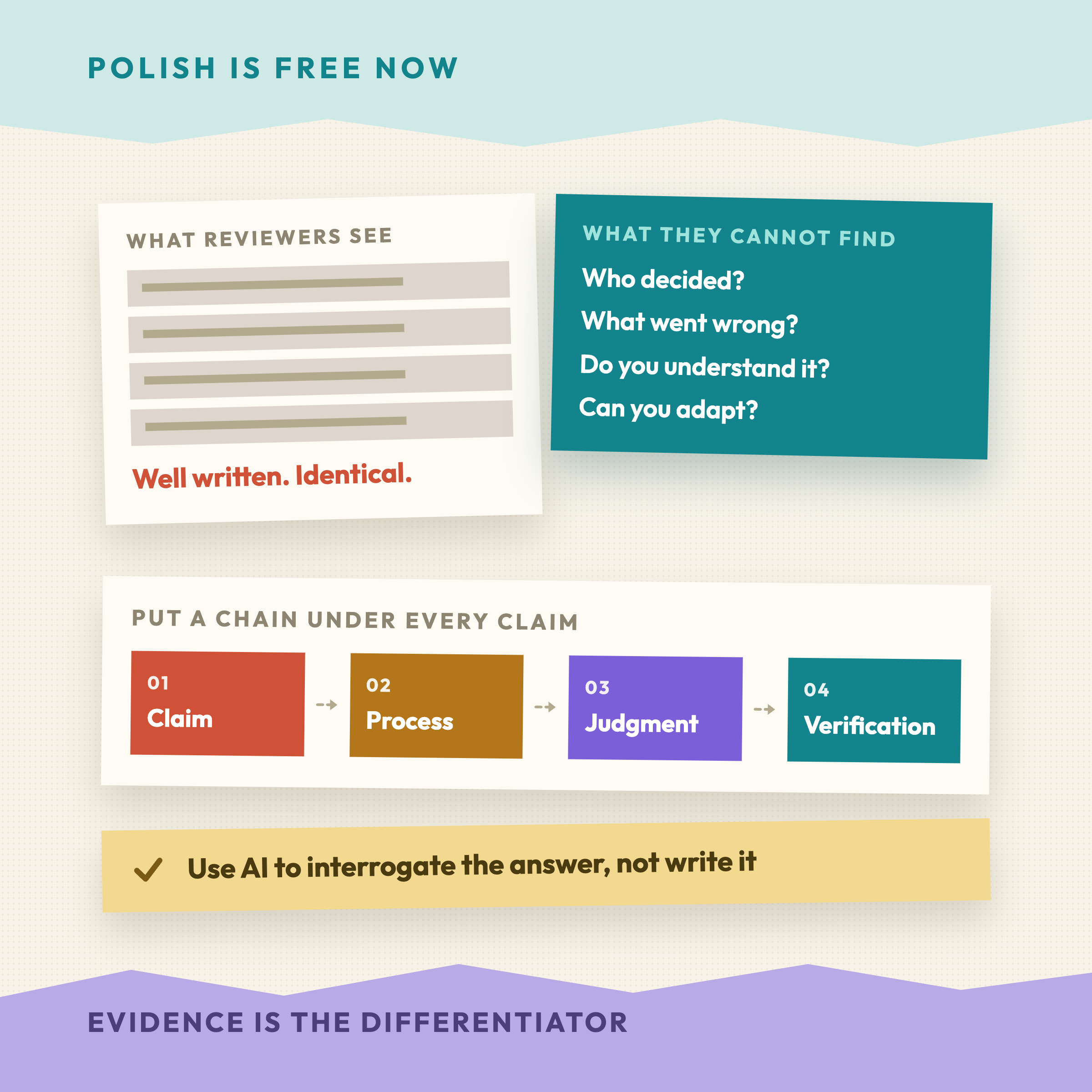
Reviewers were not described as rejecting AI-assisted writing because the grammar was bad. They were tired because the answers converged. The writing was probably competent, well structured, relevant to the role — and still carried almost no information.
When every applicant can produce a polished response that mirrors the job description, the reviewer still cannot answer the questions they actually care about:
- Who made the underlying decision?
- What went wrong during the work, and what did you do about it?
- Do you understand the code, analysis or product you submitted?
- Can you adapt when a constraint changes?
Here is the paradox for every AI job-search tool, including ours. The better a tool becomes at making everyone sound like a qualified candidate, the more efficiently it erases whatever made one candidate different from another. Polish is now free, and the mistake is continuing to treat something free as though it still proves something.
Why Hiring Systems Want Stronger Authenticity Signals
The DeepMind episode landed in a market already buckling under volume. Greenhouse's 2026 recruiting benchmarks analyzed more than 640 million applications across over 6,000 companies from 2022 through 2025, and found a 412 percent increase in annual applications handled per recruiter, with smaller recruiting teams managing substantially larger pipelines.
Greenhouse's 2026 AI in Hiring Report frames the consequence as a trust problem. Candidates use AI to move faster, recruiting teams use automation to survive the volume, and hiring managers have a harder time telling what is authentic, what is assisted and what is overstated.
Those findings do not prove that every employer runs the same algorithm, and they cannot establish that an automated system caused any particular rejection. What they do show is a reinforcing cycle:
- Candidates submit more applications at lower cost.
- Recruiters face a larger screening burden.
- Employers add automation, verification and review layers.
- Candidates respond with more keywords and generated customization.
- Applications converge further, and trust falls again.
The way out of that loop is not faster generation. What matters is evidence density — how much verifiable information each sentence actually carries.
Move From Copy Competition to Evidence Competition
Match the job without copying the job description
A resume still needs the vocabulary an employer recognizes. Relevant skills, methods and responsibilities should be named accurately, and using the employer's terms where they honestly describe your work is good practice rather than gaming.
But alignment is not sentence-level imitation. If a posting asks for someone to build scalable data pipelines, and every bullet on your resume suddenly says you built scalable data pipelines, the reviewer learns nothing about scale, bottlenecks, your specific contribution or how you knew it worked.
Compare a generic claim with an evidence-rich structure:
Illustrative structure only — replace every detail with truthful evidence from your own work: Found duplicate events that overstated weekly activation by 8.4 percent, traced the error to retry logic, rewrote the deduplication rule and added dbt tests before the corrected metric entered product reporting.
The writing style is not the valuable part, because AI can supply that in seconds. What matters is the sequence of problem, diagnosis, decision and verification, and that sequence has to come from you.
Build an evidence chain beneath every claim
Each important resume line should expand into four layers:
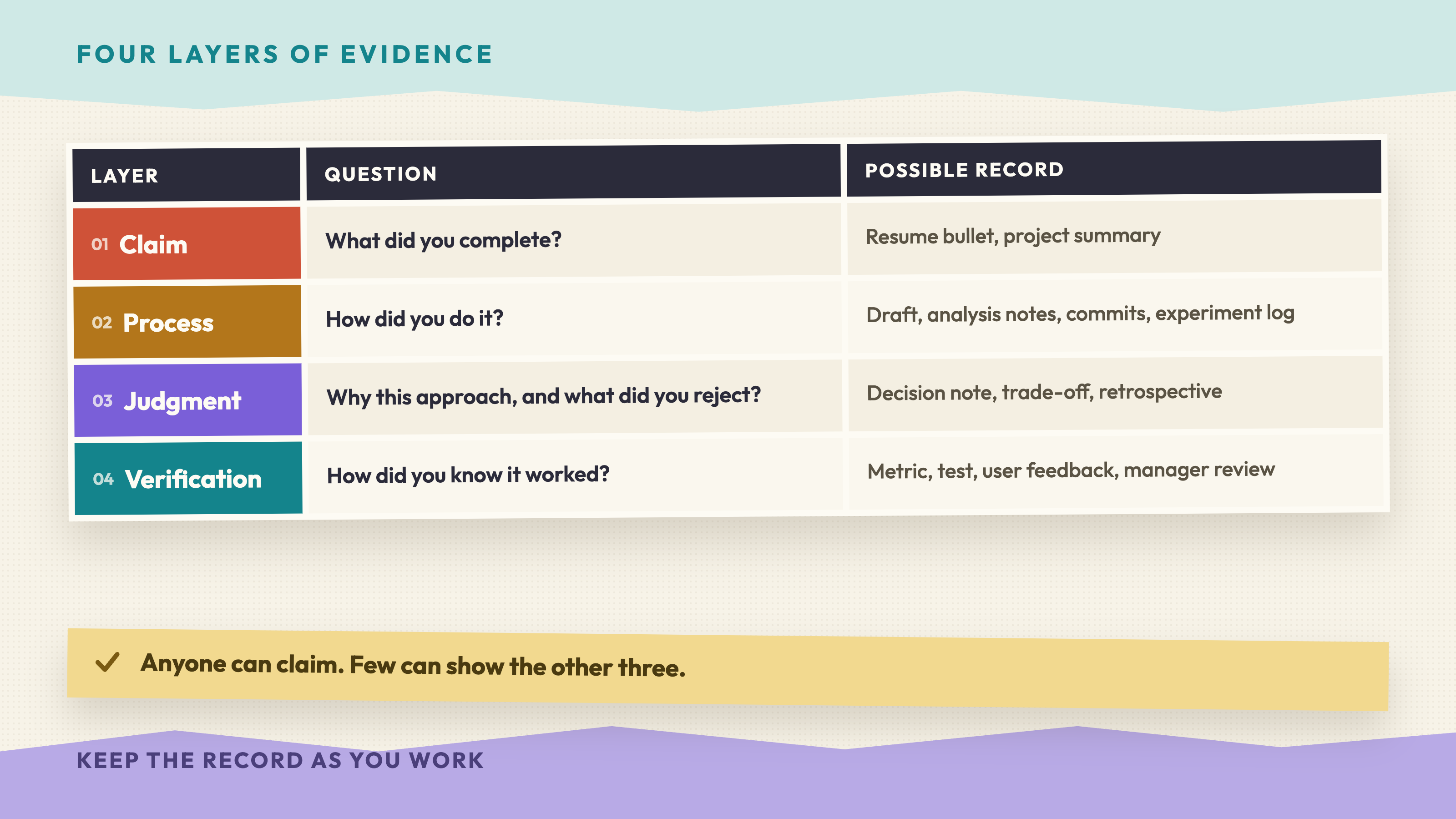
You do not need to send every artifact with an application. You do need to be able to walk through the chain when someone asks. When the work is confidential, anonymize the setting and discuss methods, constraints and your personal contribution without disclosing protected information, because proving your competence never requires leaking your employer's data.
Replace participation language with decision points
AI turns a messy group project into a smooth collaboration story almost by default: participated in discussions, coordinated stakeholders, drove delivery. It reads as complete and says nothing about what you personally contributed.
The differentiating material is almost always the moment a judgment was required:
- When did the original approach fail?
- What alternative did you propose?
- What disagreement or constraint shaped the final choice?
- How was the decision tested?
- What would you change if you did it again?
There is no universal best answer to any of those, which is exactly why they work. A question with no template answer is the fastest way to demonstrate that an experience genuinely belongs to you.
Prepare work you can open up live
A portfolio page, repository or demo video is an entry point, not a proof. It shows a finished artifact while saying little about whether you understand how it came together.
In an interview you should also be able to explain the architecture in real time, describe a version that failed and why, adapt the approach when handed a new constraint, and say plainly which parts AI generated and which parts you reviewed, tested and changed yourself.
Using AI is not the credibility problem. Being unable to explain, adapt or take responsibility for what it produced is the whole of the problem.
Use AI as an Evidence Editor, Not a Ghostwriter
The shift worth making is from asking AI to write the answer to asking it to interrogate the answer.
Useful requests:
- Identify which job requirements your resume has not yet proved.
- Push on each bullet with how, why, and how do you know.
- Flag numbers and adjectives that no record supports.
- Play the interviewer and ask follow-up questions about your trade-offs.
- Strip generic enthusiasm, stock openings and repeated keywords.
Requests to refuse:
- Inventing project scale, metrics or technical detail.
- Flattening your voice into a generic professional register.
- Reshaping your actual responsibilities to mirror a posting.
- Deciding your work authorization, or whether an employer will sponsor.
- Mass-submitting roles you have not read.
For International Students, Consistency Is Part of the Evidence
An international applicant's history usually appears across a resume, an application form, LinkedIn, a portfolio and recruiter conversations. When AI rewrites each surface separately, small inconsistencies creep in: a title that shifted, dates that no longer line up, a technical stack that grew with each rewrite, or two different answers about current and future work authorization.
Those gaps are rarely deliberate, and they cost trust anyway. Avoid rewriting each surface in isolation, because that is precisely how two different versions of the same job end up in front of the same recruiter. Before submitting, check that dates, titles and project roles agree across every surface; that each listed skill has real work behind it; that your work-authorization answers are accurate and consistent; that you can say where AI helped and how you verified the result; and that source records exist for the claims most likely to draw a follow-up.
No tactic guarantees that a human will read your resume. As the Google spokesperson put it, reaching the team directly still comes with no shortcuts to getting hired. What you control is whether the material is specific, coherent and checkable when a person finally opens it.
Frequently Asked Questions
Should candidates stop using AI for resumes?
No, and the story does not support that conclusion. AI is genuinely useful for structuring, compressing, extracting requirements and finding evidence gaps. The risk comes from submitting experience you cannot verify, or letting every answer collapse into the same template.
Shouldn't a resume closely match the job description?
It should align with the role's real skills and responsibilities, but it does not need to copy sentences. Accurate terminology plus truthful scale, constraints, decisions and results carries far more information than repeated keywords.
How can a student without full-time experience show process evidence?
Coursework, research, student organizations, open-source contributions and personal projects all qualify, provided you can explain how the problem was defined, which part was yours, how the approach changed along the way, and how you checked the result.
What if the strongest work is confidential?
Do not disclose protected code, data or customer information. Anonymize the setting and discuss method, constraints, personal judgment and non-confidential outcomes. When in doubt, follow your employer's policy and confirm with the person responsible.
Can direct outreach bypass the hiring process?
It can add context and help a team notice an application earlier, but it does not replace the formal application, the qualifications or the interview. Do not ask for internal forms, and do not present yourself as having a special channel.
Is this how hiring works at other companies?
There is no basis for assuming so. The reporting describes one team's practice at one company, and Google disputed part of the characterization. Treat it as a signal about what reviewers are tired of reading, not as a description of any employer's pipeline.
Put It Into Practice
Pick the three most important bullets on your resume. For each, write down where the underlying record lives, what judgment you made, and how the result was verified. If any one of those three is missing, go find the evidence before you polish the sentence again — a better-written version of an unverifiable claim is still an unverifiable claim.
EdAIX Job Agent is built for the checking half of that work rather than the writing half. Its browser extension scores a posting you are viewing on LinkedIn, Indeed or Built In against your resume and returns a 0-100 match score, a Strong, Good or Weak Match verdict, your strongest matches, your gaps, the keywords you are missing, one recommended action before applying, and whether the posting mentions sponsorship as Yes, No or Not mentioned. Pasting a job description alongside your resume on the web produces an ATS match score plus a requirements breakdown covering responsibilities, hard skills, soft skills, experience and education, showing which ones your resume already evidences.
Two honest limits, in the spirit of an article about verifiability. The apply-now, optimize-first or skip triage described in this article is an editorial method rather than something the product outputs; the tool gives you a score, a verdict and a gap list, and the judgment stays yours. And the sponsorship field reports what the employer wrote in the posting, which is frequently nothing at all — it cannot determine your legal work authorization or predict whether a company will sponsor you. Take those questions to the employer, your DSO or qualified counsel.
Sources
- The Star / Bloomberg — Google's AI team tells job seekers its HR filters are unreliable
- Yahoo Finance / Bloomberg — Google's AI Team Tells Job Seekers Its HR Filters Are Unreliable
- Greenhouse — Hiring Benchmarks 2026
- Greenhouse — The 2026 AI in Hiring Report
Disclaimer
This article is for educational and general informational purposes only. Descriptions of Google DeepMind's recruiting process come from media reporting and should not be treated as official Google policy, or as evidence that other teams or companies use the same process. EdAIX does not guarantee interviews, offers or sponsorship outcomes. Confirm individual work-authorization questions with the employer, your DSO or qualified counsel.