
Source review date: August 18, 2026. This article is based on LinkedIn's official press release and the Economic Graph Research Institute report, The AI Talent Divide. Unless otherwise noted, the job, pay, education and hiring figures refer to LinkedIn platform data for the United States. The findings are descriptive and correlational. The research does not analyze OPT, H-1B or employer sponsorship.
LinkedIn's latest AI labor-market research puts unusually specific numbers behind a story most people have already sensed: AI postings pay more, one deployment-focused role is rising fast, and a degree still matters — just not in the way it used to.
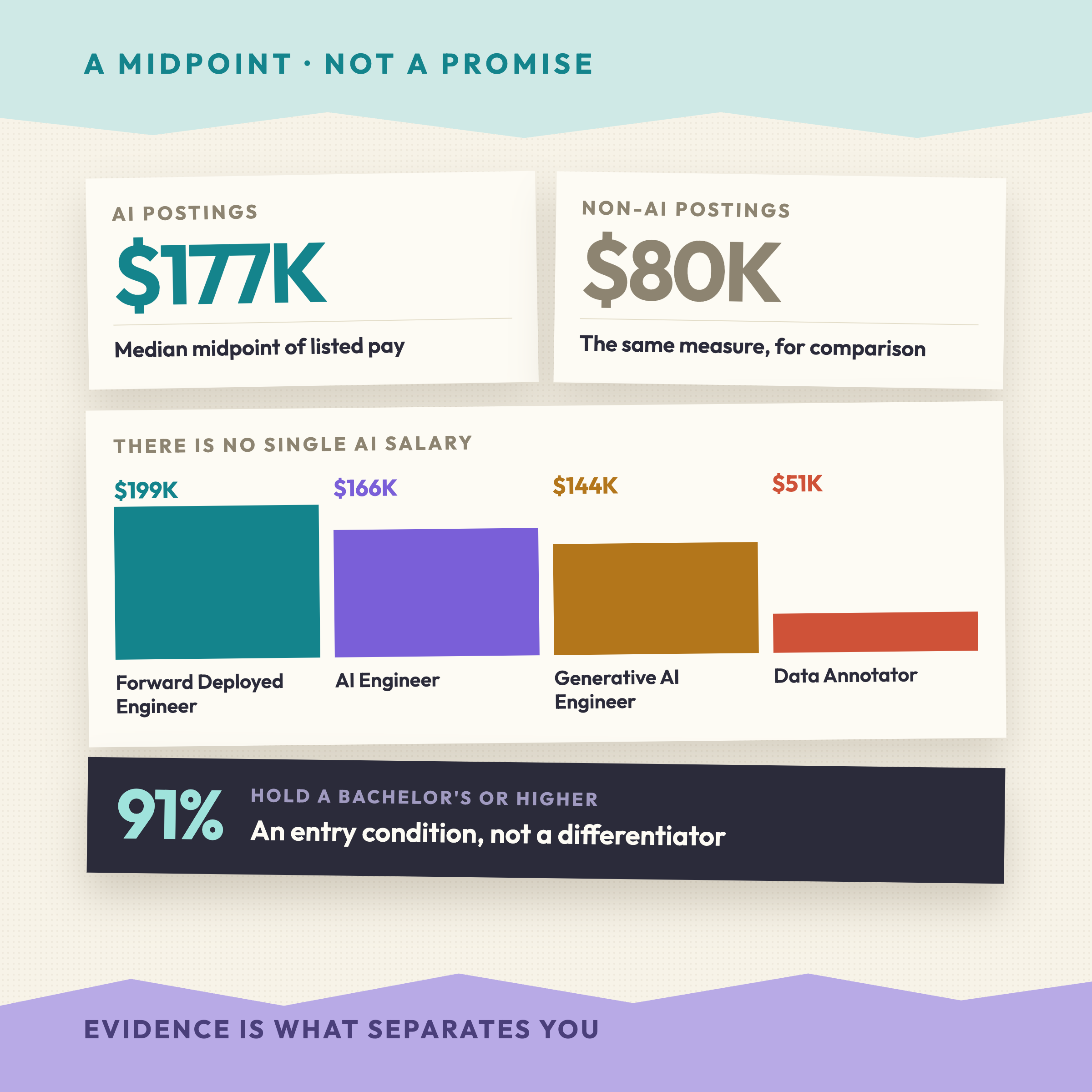
The typical AI posting lists a base-pay midpoint of about $177,000, more than double the $80,000 typical for non-AI postings. Forward Deployed Engineer has become the third most common specific AI builder occupation. And 91% of workers in AI roles hold a bachelor's degree or higher.
For international students, that combination is encouraging and easy to misread at the same time. The pay premium is real. $177,000 is not a promised new-graduate salary, and a bachelor's degree is not an admission ticket by itself — it is closer to a shared minimum that most of the competition has already met. What still separates candidates is role-specific, verifiable evidence of what they can actually do.
Read the Numbers at Their Actual Scope
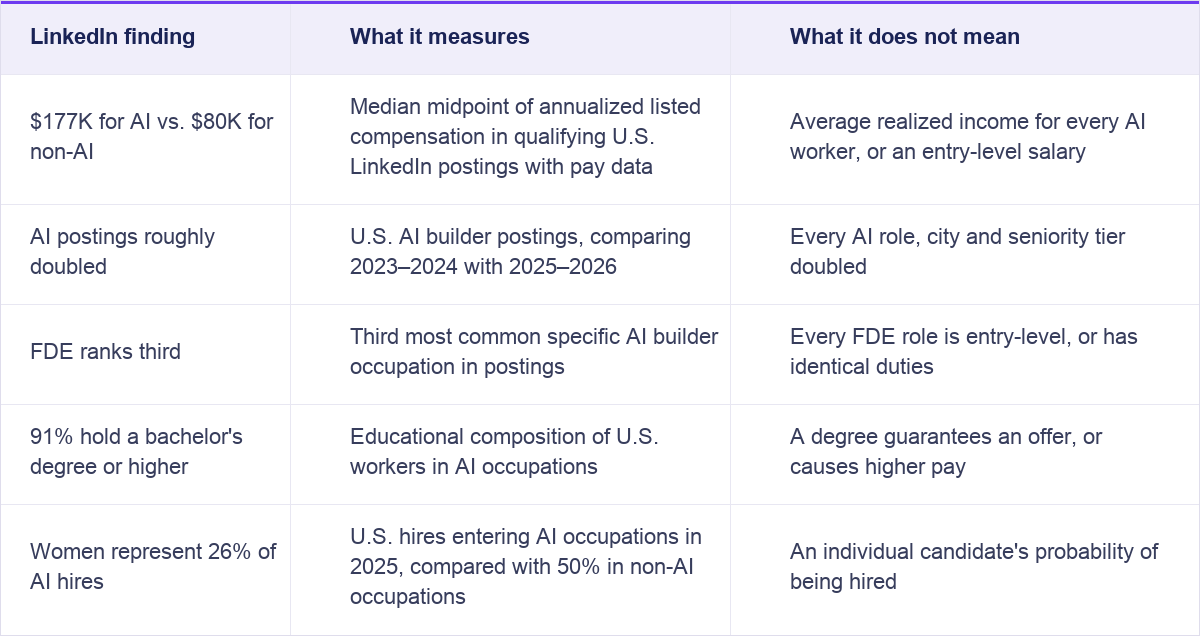
A number can come from a strong primary source and still mislead once its denominator, sample or definition drops out of the headline — which is exactly what happens when $177,000 travels alone.
Signal One: The AI Pay Premium Is Real, but There Is No Single "AI Salary"
LinkedIn reports a median midpoint of roughly $177,000 in listed base pay for a typical U.S. AI posting, more than twice the $80,000 benchmark for non-AI positions. The report notes that even the low end of the typical AI range exceeds the high end of the typical non-AI range.
The occupational detail underneath that number is more useful than the aggregate itself. In LinkedIn's 2026 chart, Head of AI, Director of AI and Member of Technical Staff sit at the top of the pay distribution. Forward Deployed Engineer has a median listed-pay midpoint near $199,000, AI Engineer near $166,000, and Generative AI Engineer near $144,000. Data Annotator, at roughly $51,000, falls below the non-AI benchmark entirely.
There is never a single "AI salary" to quote — pay moves with the role's position in the AI value chain, technical specialization, seniority and demand, and treating $177,000 as one number erases all four of those differences at once.
Use $177,000 as market context instead of a personal quote. A real comparison still needs role, location, level and company stage, plus a clear separation between base salary, bonus, equity and total compensation — and it needs the sample's limits kept in view, since LinkedIn's pay analysis only covers postings that voluntarily disclosed compensation.
Signal Two: Forward Deployed Engineer Shows Where AI Hiring Is Moving
AI Engineer and Machine Learning Engineer remain the two dominant roles, together accounting for nearly two-thirds of AI postings. But the mix underneath that stability is changing.
AI Engineer has moved ahead of Machine Learning Engineer as the single most common role, while Forward Deployed Engineer has expanded to roughly 7.3% of AI postings in 2026 and become the third most common specific AI builder occupation. LinkedIn describes FDEs as people who help organizations implement AI solutions — the job is not building the model, it is making the model work somewhere real.
The market is not only hiring people to build models anymore. It is also hiring people who can connect a model to real systems, workflows and the humans who have to trust its output.
Make sure a project aimed at FDE or Applied AI roles proves more than a model score. It should make visible:
- the user or operating problem the work actually addressed;
- how the model entered an existing product or workflow;
- constraints involving data, latency, cost or reliability;
- the engineering and product trade-offs made along the way;
- how a nontechnical stakeholder used and evaluated the result.
That checklist is an editorial application of the labor-market shift, not a direct LinkedIn recommendation.
The age data adds a related signal. Gen Z accounts for more than two-thirds of hires into both AI Engineer and Forward Deployed Engineer roles. That does not make every opening junior-friendly, but it does suggest these builder and deployment roles are creating real entry points for younger candidates rather than closing behind more senior hires.
Signal Three: A Degree Looks More Like an Entry Condition Than a Differentiator
Around 91% of workers in U.S. AI roles hold a bachelor's degree or higher, compared with 82% in non-AI occupations. The concentration climbs further in the highest-paid jobs:
- 98% of Head of AI hires hold at least a bachelor's degree; nearly 70% hold a graduate degree and about 20% hold a doctorate.
- More than 97% of Director of AI and Member of Technical Staff hires hold at least a bachelor's degree.
- Roughly 60% of Member of Technical Staff hires hold graduate degrees.
The report establishes that formal education is heavily concentrated in the current AI workforce. It does not establish that a degree causes high pay, or that any credential automatically improves a candidate's odds against everyone else in the pool.
For an international student already completing a U.S. bachelor's, master's or doctorate, the practical read is narrower: the degree likely clears a common threshold, and most direct competitors clear the same one. Education explains why a candidate is eligible for the pool. It explains less and less about why a specific candidate gets picked out of it.
That is an editorial inference from the concentration data, not a conclusion LinkedIn tested directly. Differentiation still depends on several things — relevant experience, communication, network, location and work authorization among them — but verifiable work evidence is the one factor a candidate can most directly build up on their own.
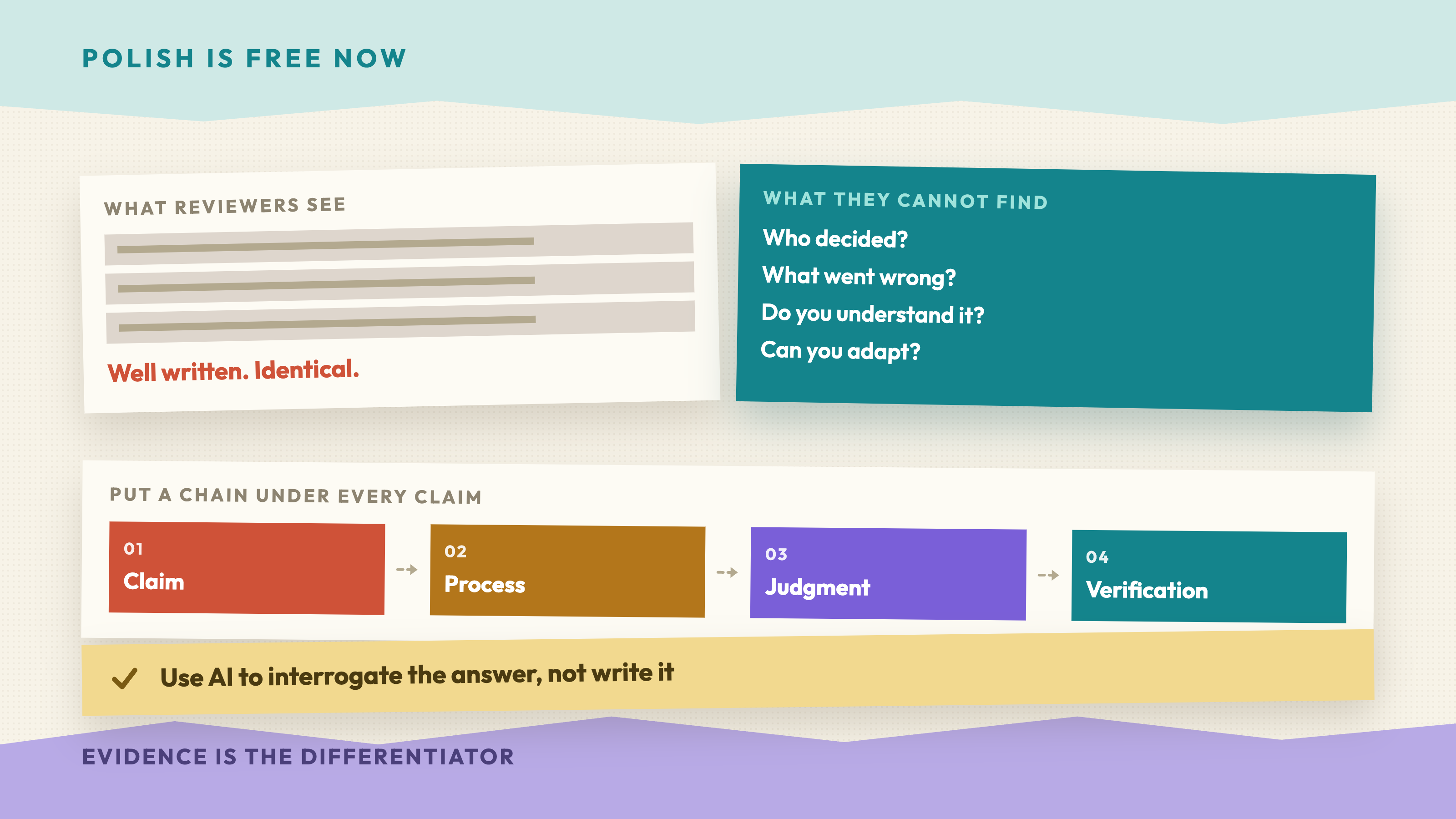
The mistake is treating the degree as the differentiator when the data shows the opposite: it is close to table stakes, and the real gap opens somewhere else. Every strong claim on a résumé should connect to four layers:
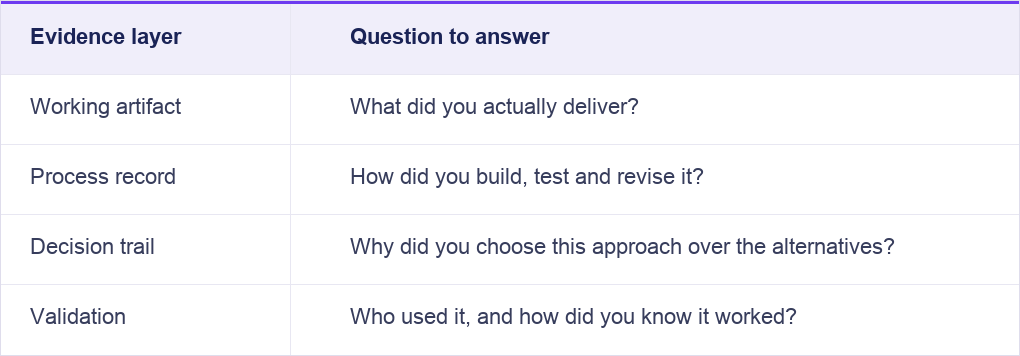
That four-layer structure is the cleanest product implication for Vibe ID™ here. It should not become another AI-generated profile that says the same things everyone else's does. Its job is to organize projects, decisions, iteration and validation into evidence that another person can actually examine.
Signal Four: The $177K Headline Cannot Be Separated From the 26% Access Gap
LinkedIn's release is not only a pay story. It is also an unequal-access story, and the two halves were published together for a reason.
Women accounted for 26% of U.S. AI hires in 2025, versus 50% of hires into non-AI occupations. Representation was even lower in several of the highest-paid AI roles: 20% for Head of AI, 26% for Director of AI, and 18% for Member of Technical Staff.
Data Annotator roles sit at the other end of the market. They carry lower formal-education barriers and greater representation of women, and they are also the lowest-paid AI occupation in the entire study.
AI is creating real high-value opportunity, but access to the different levels of that opportunity remains uneven, and a platform serving job seekers should never extract the $177,000 figure for marketing while quietly dropping the representation finding that motivated the research in the first place.
What matters for an individual candidate is not the group average — it is whether the specific evidence in front of a recruiter closes the gap those averages describe. Group-level data does not decide any one outcome, but it is a reminder that access to AI work involves more than learning a skill. Project opportunities, mentorship, recruiting channels and visibility all shape who actually reaches the highest-value roles.
A Practical Plan for International Students
Choose a role family, not an "AI" label
Focus on the role family first, then match your evidence to it — a single generic AI résumé will not serve all three groups below:
- Builder roles: AI Engineer, Machine Learning Engineer, Generative AI Engineer.
- Deployment and application roles: Forward Deployed Engineer, Applied AI.
- Senior technical and leadership roles: Member of Technical Staff, Director of AI, Head of AI.
Each family rewards different evidence, and applying the same résumé to all three usually means it fits none of them well.
Use pay data as a research starting point, not a target
Keep going by level, metro area, company stage and compensation structure. New graduates in particular should avoid anchoring on a market aggregate that includes senior leadership and specialized technical roles as if it described their own starting salary.
Treat the degree as context and evidence as the body
Education should stay clear and credible on the résumé, but the space that actually persuades a reader should hold real projects, engineering decisions, deployment constraints and validated outcomes. A course list rarely differentiates candidates who already share similar credentials.
Add last-mile evidence for FDE and Applied AI roles
Beyond code and model performance, show integration, reliability, cost, user feedback, iteration and communication. The market increasingly needs people who can move a system from a demo into something a team actually keeps running.
Audit work authorization separately from everything above
LinkedIn's study does not examine OPT, STEM OPT, H-1B or employer sponsorship at all. High pay, rapid growth and a young hiring profile say nothing about whether a specific job fits an individual immigration timeline — that has to come from the posting, the application questions and the employer's own policy.
EdAIX Job Agent shows a job's H-1B sponsorship status alongside a match score comparing the posting to the evidence already in your résumé, so you can see fit and sponsorship status together before you decide whether to apply, tailor first, or move on. It cannot determine your legal eligibility or guarantee that an employer will sponsor you.
FAQ
Is $177,000 the average salary for AI jobs?
No. It is the median midpoint of annualized listed compensation among qualifying U.S. LinkedIn postings with disclosed pay. It is not the mean realized income of all AI workers, and it is not the average new-graduate salary.
Does the figure include stock and bonuses?
The research analyzes annualized listed compensation and describes the benchmark as a base-salary midpoint. Check each posting for bonus, equity and benefits separately rather than treating $177,000 as total compensation.
Does FDE ranking third make it an entry-level role?
No. The ranking describes posting share, not required seniority. Individual FDE roles can differ widely in engineering depth, customer interaction, location and experience expectations.
Does the 91% degree concentration mean a career changer needs another degree?
Not by itself. The report describes the current workforce; it does not compare the success rate of different transition paths into it. Whether more education helps should be weighed against the target role, your current foundation, cost, time and immigration situation — not against this one statistic.
Does the study cover every job in the AI economy?
No. The AI Talent Divide focuses on AI engineering and technology-building occupations. It excludes other parts of the AI value chain such as infrastructure, data centers and governance.
Put It Into Practice
Pick one AI role family, then pull four things out of your strongest recent project: a working artifact, a process record, a decision trail, and a validation story. Use Vibe ID™ to organize that evidence into something a recruiter can actually examine, then use EdAIX Job Agent to check each posting's sponsorship status and match score before deciding where to spend your application time.
Sources
- LinkedIn Pressroom — New LinkedIn Research Finds Women Account for Just 26% of AI Hires as AI Jobs Surge
- LinkedIn Economic Graph Research Institute — The AI Talent Divide: Strong Demand and Pay, Uneven Returns