
AI can make a job search faster, but its greatest value may not come from automatically submitting more applications. It comes from helping candidates understand complex information, compare evidence, and make better decisions before applying.
Google’s AI & Economy ATLAS report offers a useful way to understand this distinction. Its findings suggest that AI adoption is happening task by task rather than job by job. Applied to job searching, the practical lesson is to use AI for analysis, organization, and preparation while keeping accuracy, judgment, and final submission under human control.
What Google’s ATLAS Study Reveals About AI at Work
ATLAS stands for Activity, Task, Landscape, and Adoption Study. According to Google’s official introduction to ATLAS v1.0, its first dataset was built from 15 million aggregated and de-identified interactions across the Gemini App, AI Mode, and the Gemini API. The findings span more than 150 countries, 140 languages, approximately 800 occupations, and 4,000 tasks.
One of the report’s most important findings is that workplace AI adoption appears to be broad but shallow. AI use appeared in 68% of occupations, collectively representing approximately 90% of employment in the United States. Yet within a typical occupation, AI was used for only about 21% of tasks.
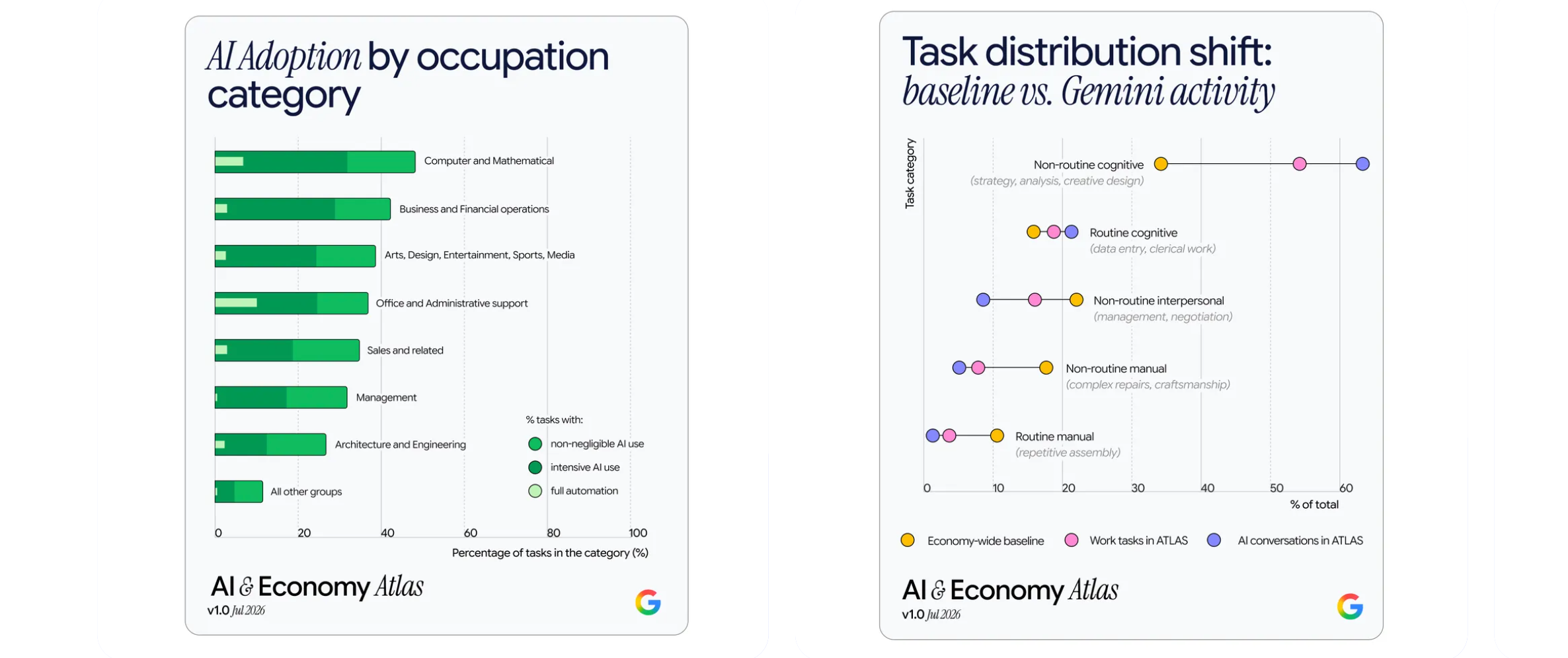
The central ATLAS finding: AI use is widespread across occupations but concentrated in only a subset of tasks within each occupation. This suggests that adoption is happening task by task—not necessarily job by job.
This distinction matters because discussions about AI and employment often focus on whether an entire profession will be automated. ATLAS presents a more selective pattern: people may use AI to retrieve information, explain unfamiliar material, compare alternatives, generate ideas, or prepare drafts while remaining responsible for the wider workflow and its outcome.
Google also found that most workplace AI interactions involved collaborative activities such as information retrieval, learning, ideation, and strategy. Fewer than 10% of workplace interactions in the dataset fully automated a task.
Collaboration is the dominant pattern in the ATLAS data: people are using AI more often to retrieve, learn, compare, plan, and draft than to hand over an entire task without review.
The report also shows that AI assistance is not limited to office-based knowledge work. Workers in manual and technical occupations are using conversational and multimodal AI for adjacent activities such as troubleshooting, diagnostics, interpreting test results, and learning during physical work. AI does not need to perform the central activity of an occupation to influence how that work is carried out; it can support the research, communication, interpretation, and preparation surrounding it.
ATLAS also has important limits. It examines observed usage across selected Google AI products and provides an early view of a rapidly changing landscape. It does not prove that AI increases productivity, causes job loss, improves interview rates, or produces better hiring outcomes.
How to interpret the report correctly: ATLAS shows where and how people use AI. It identifies adoption patterns, but it does not prove productivity gains, job displacement, higher interview rates, or better hiring outcomes.
What the Research Means for Job Seekers
A job search is not one activity. It combines job discovery, job-description analysis, qualification comparison, employer research, résumé tailoring, application completion, interview preparation, and follow-up. These tasks should not all receive the same level of automation.
Tasks involving large amounts of text, comparison, organization, or repetition are often suitable for AI assistance. Decisions involving truthfulness, legal status, personal priorities, or employer-facing claims require direct human control. This is also the difference between AI-assisted job searching and blind auto-apply. Automatic submission may increase application volume, but it can reduce relevance and context when roles are selected or applications are completed without meaningful review.
Use AI when a task involves text, comparison, organization, or repetition. Keep human control when a decision involves truth, legal status, career direction, or claims presented to an employer.
A task-based approach does not reject automation. It applies different levels of automation to different parts of the process. Organizing saved jobs or summarizing a posting carries less risk than answering a work-authorization question or submitting a résumé that represents a candidate’s actual experience.
How to Use AI in a Job Application
Start by using AI to structure the job description. A long posting may combine required qualifications, preferred experience, responsibilities, technical skills, seniority expectations, location requirements, and work-authorization language. AI can separate these signals so you can identify what appears essential, what is optional, and what needs further research. It should help you read the original posting more systematically, not replace it.
Next, compare the role with your actual résumé. A résumé is not simply good or bad; it may be well aligned with one position and poorly aligned with another. The comparison should examine whether your résumé contains clear evidence of the role’s most important skills, expected experience level, project ownership, measurable impact, industry relevance, and stakeholder communication.
When AI identifies a gap, determine what kind of gap it is. Sometimes the experience exists but is not communicated clearly. For example, “Built weekly dashboards using SQL and Tableau” demonstrates technical execution, while “Built weekly SQL and Tableau dashboards that helped marketing and operations leaders identify acquisition and retention trends” also communicates audience and business impact.
In other cases, the qualification is genuinely missing. Adding a tool or skill you have never used would not resolve the gap; it would make the application inaccurate. A third possibility is that the role is not realistic because of seniority, licensing, location, security-clearance, or work-authorization requirements.
Not every résumé gap should be fixed with a keyword. A gap may mean:
- The experience exists but is not communicated clearly.
- The qualification is genuinely missing.
- The role is not a realistic fit.
Each situation requires a different response.
When the underlying fit is credible, AI can help tailor the résumé by improving emphasis, terminology, ordering, and clarity. It can bring relevant experience forward, strengthen a professional summary, clarify project scope, and highlight measurable results the candidate can support.
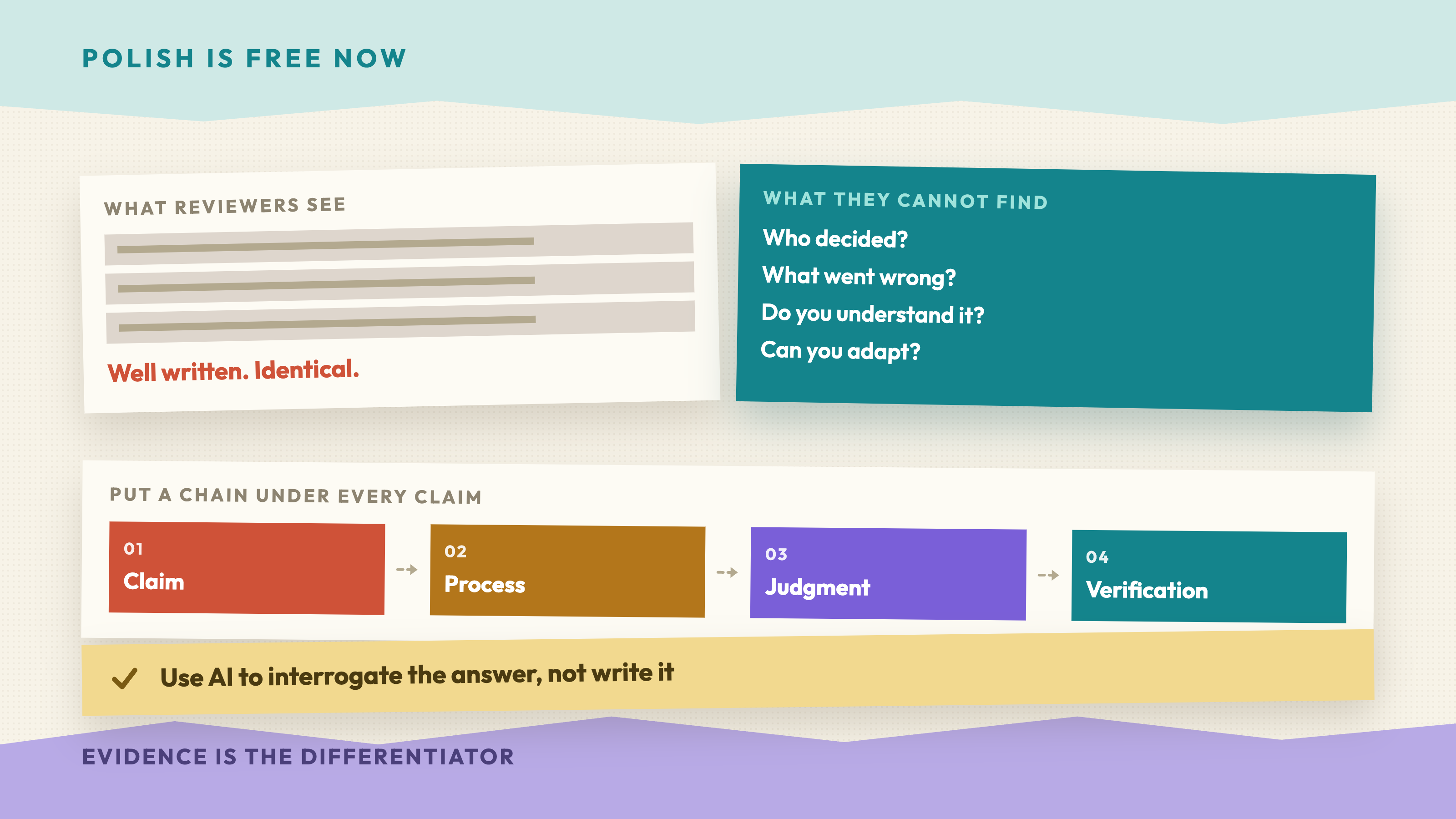
A useful tailoring test: If a change makes your real experience clearer and more relevant, it is tailoring. If it creates experience, skills, ownership, or results that did not exist, it is fabrication.
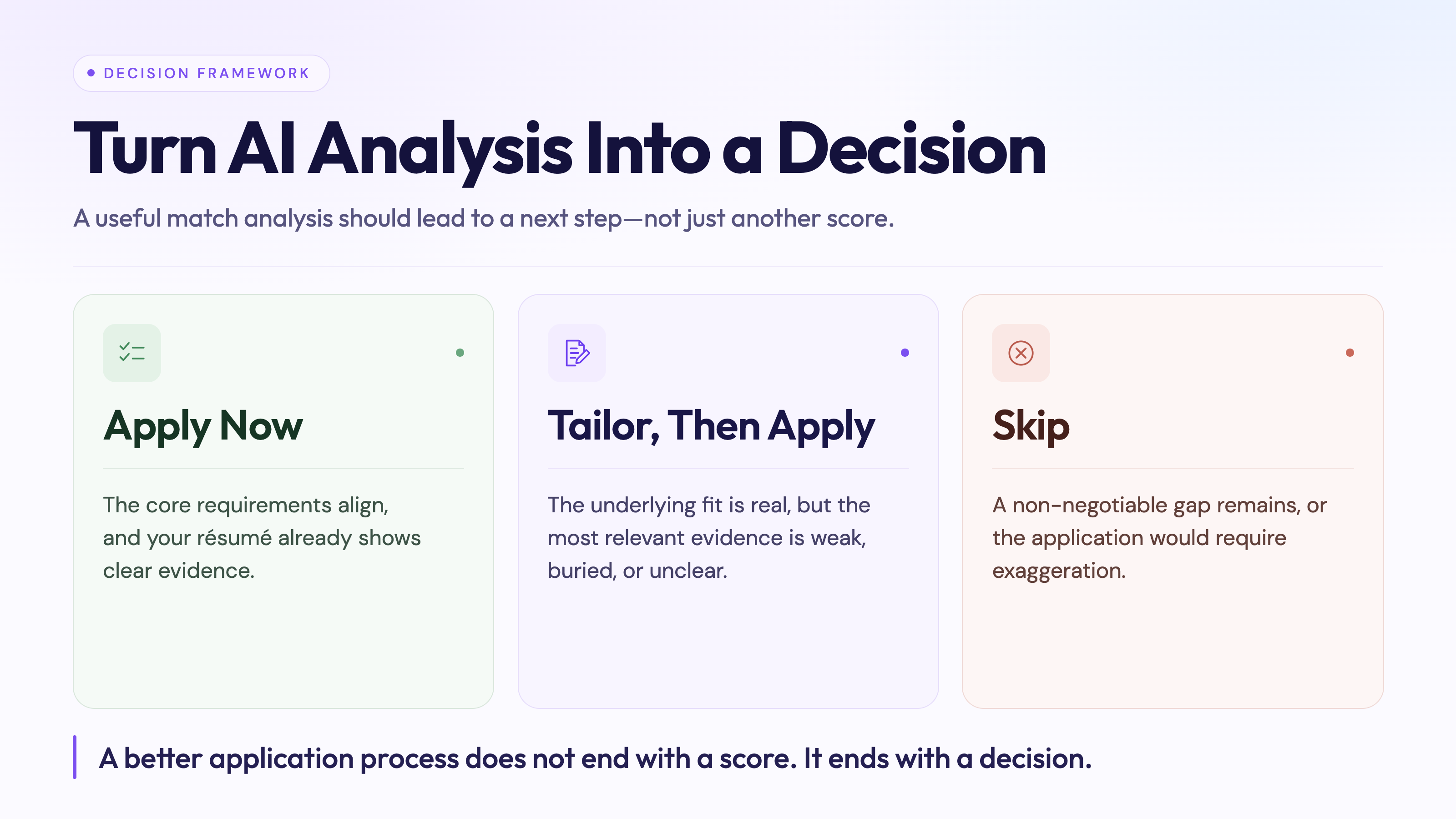
The analysis should ultimately support one of three decisions: apply now, tailor before applying, or skip the role. Apply when the core requirements align and the résumé already contains relevant evidence. Tailor when the experience is real but poorly communicated. Skip when a non-negotiable requirement is missing or applying would require exaggeration.
A match score can help prioritize these decisions, but it cannot predict hiring. It does not know the full applicant pool, internal candidates, referrals, hiring-manager preferences, budget changes, or how well a candidate will interview.
Use a match score to answer “Is this application worth more time?” Do not use it to answer “Will I get an interview?”
What Should Remain Human
The more a task affects your identity, qualifications, legal status, or career direction, the less appropriate full automation becomes. AI may suggest career options, but it cannot fully understand your financial needs, personal priorities, family responsibilities, risk tolerance, or long-term goals. It may rewrite a résumé statement, but only you can confirm whether that statement accurately represents your work.
Work-authorization questions also require caution. AI can surface language related to sponsorship, citizenship, security clearance, or current authorization, but it cannot confirm how an employer will handle an individual case or provide immigration advice.
Final review should remain under human control. Before an application reaches an employer, verify the résumé version, contact details, employment dates, salary expectations, screening responses, and work-authorization answers. You should know exactly what information is being submitted on your behalf.
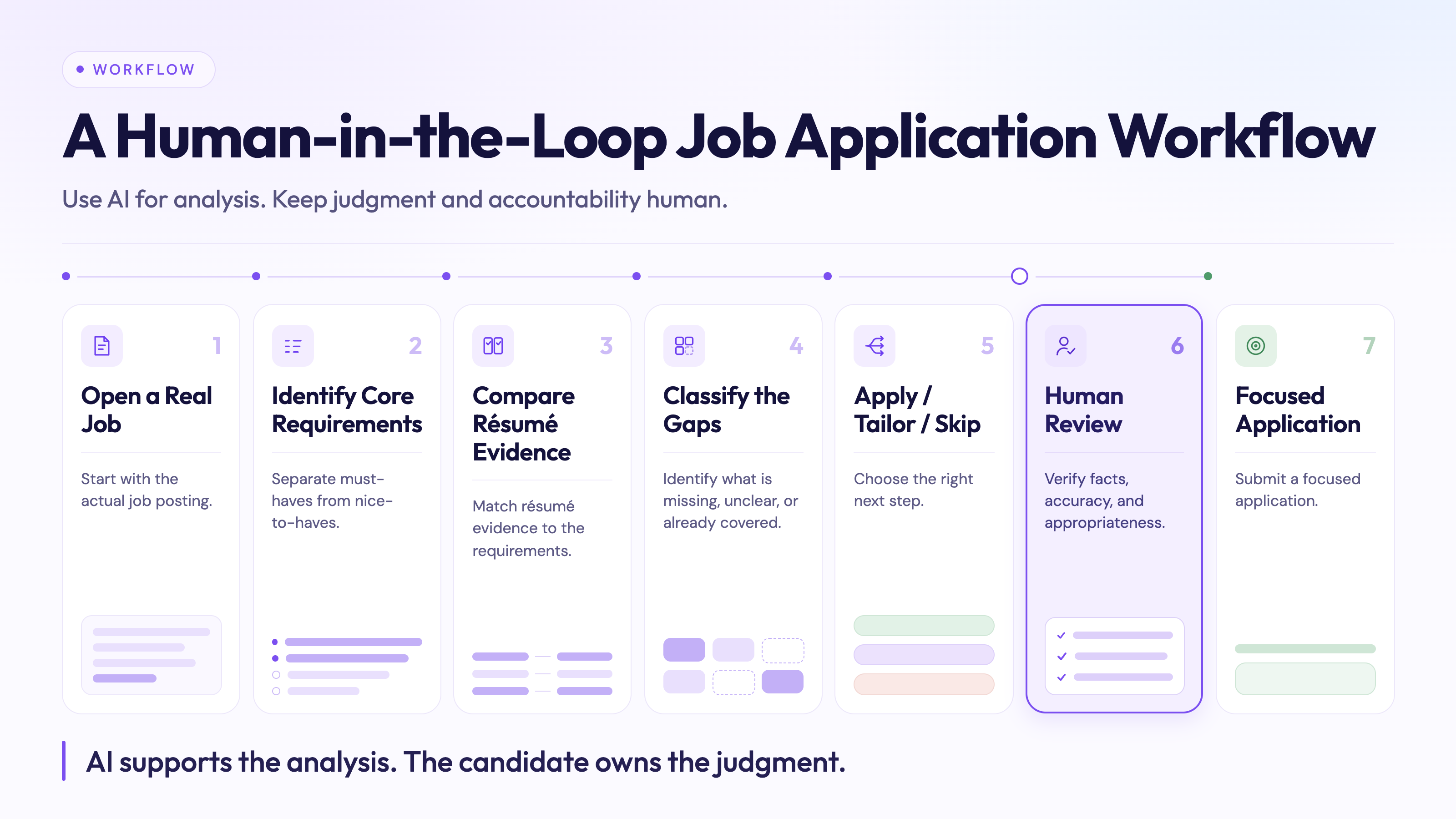
A practical human-in-the-loop workflow is therefore simple: open a real job description, identify its core requirements, compare them with résumé evidence, classify the gaps, review practical constraints, decide whether to apply or skip, tailor without changing the facts, and review the final application yourself.
How EdAIX Applies This Approach
EdAIX Job Agent applies this task-based model to a role the candidate is already considering. It helps compare an open job description with the candidate’s résumé, surface relevant alignment and gaps, and support role-specific résumé tailoring. The candidate still verifies the information, evaluates the opportunity, and controls the final application.
The Bottom Line
Google’s ATLAS research suggests that AI is currently being adopted selectively and collaboratively. People use it across many occupations, but usually for individual tasks rather than complete workflows.
Job seekers can apply the same principle. Use AI to process complex job descriptions, compare requirements with résumé evidence, identify meaningful gaps, and improve application clarity. Do not use it to invent qualifications, make legal decisions, or submit unchecked information.
The strongest AI job-search workflow is not one in which the candidate disappears. It is one in which the candidate makes better decisions with better support.
Make Your Next Application More Focused
Compare one real job description with your résumé, understand the gaps, and decide whether to apply, tailor, or move on.
Frequently Asked Questions
How should I use AI to apply for jobs? Use AI to analyze the job description, compare it with your résumé, identify missing evidence, and prepare a tailored draft. Keep verification, career judgment, and final submission under your control.
Should I use an AI auto-apply tool? Auto-apply tools may increase application volume, but they can reduce relevance and control. Review every role and all employer-facing information before submission.
Can AI tailor my résumé? AI can improve ordering, terminology, clarity, and emphasis. It should not invent skills, projects, responsibilities, job titles, or results.
Is a job-match score a hiring probability? No. It measures visible alignment between a résumé and a job description. It cannot account for the applicant pool, internal candidates, referrals, hiring-manager preferences, or interview performance.
Can AI identify visa sponsorship opportunities? AI can surface sponsorship and work-authorization language in a posting, but it cannot guarantee sponsorship or provide immigration advice.
Primary source: Google — Understanding the AI Economy: The First ATLAS Report