

Note: This article draws on publicly available information, including the Hiring Agent open-source project and public documentation from major recruiting platforms. The pipeline described here reflects common industry patterns, not a universal workflow used by every employer.
Ask ten job seekers what happens after they hit submit, and most describe the same thing: an ATS reads the resume, gives it a score, and either lets it through or does not. The model is comforting because it implies one obstacle with one fix — find the right keywords, clear the bar, get the interview.
It is also wrong in a way that quietly costs people interviews. An applicant tracking system is, at its core, a database and a workflow tool. It stores applications, moves them between stages, and records what recruiters decide. Scoring resumes is not its central job, and at many companies it does no scoring at all. The most important thing to understand is that no single number decides whether a recruiter ever opens your profile.
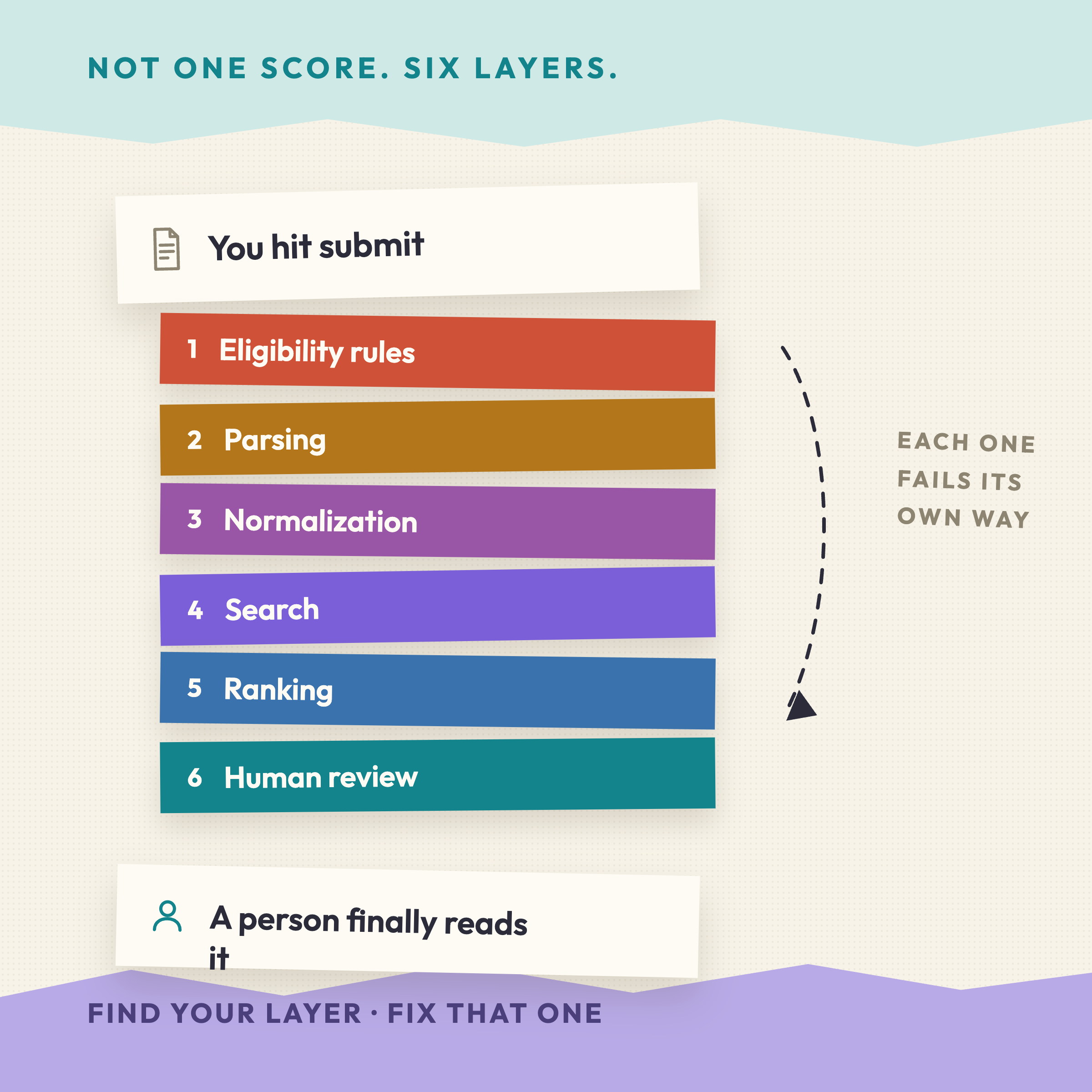
What stands between your submission and a human being is a chain of processing steps, and each link fails in its own way. This article walks through six of them.
Beyond the ATS Score
The phrase "ATS score" comes mostly from resume-checking tools, not from the systems employers actually run. Those tools compare your resume against a job description and return a number. That number can be genuinely useful as feedback. It is not a value the employer's system computes, stores, or sorts by.
Meanwhile, real hiring stacks are assembled from parts. A company might use one platform to receive applications, a separate parsing service to read the files, a taxonomy layer to standardize titles and skills, a search index for recruiters, and — sometimes — an AI matching feature that is switched off by default. Two companies using the same brand-name ATS can behave completely differently depending on how each one configured it.
So the useful question is not what your score is. The real question is which layer your application stops at, because the fix for a parsing failure looks nothing like the fix for a search-visibility problem.
Layer 1: Eligibility Rules
Before anything reads your experience, hard rules run. Work authorization and sponsorship needs, location and onsite requirements, minimum years, required licenses, sometimes a knockout question written specifically for the role.
These are almost always answered by you, in the application form, not inferred from your resume. That matters more than it sounds. A candidate who is authorized to work but selects the wrong option in a dropdown has been filtered before a single line of their experience was read, and there is usually no appeal and no notification.
The mistake here is treating application questions as paperwork to rush through after the resume is done. Read every eligibility question slowly and answer it as the employer defines it, not as you interpret it.
Layer 2: Parsing
Your PDF does not stay a PDF. A parser converts it into text and structure — names, dates, employers, titles, education, skills — and that extracted version is what most downstream layers actually see.
Parsers fail in predictable ways. Multi-column layouts get read across instead of down, interleaving two unrelated jobs. Text inside images or graphics extracts as nothing. Tables collapse. Icons standing in for labels leave a phone number with no indication it is a phone number. Dates written as "'22–'24" may not register as employment dates at all. Headers and footers sometimes get stripped along with the contact details sitting in them.
What makes this layer dangerous is that it is silent. Nothing tells you your resume arrived with two years missing. The design fix is unglamorous and reliable: one column, standard section headings, selectable text, dates in a consistent and explicit format, and a final check by opening the file and copying all the text into a plain document to see what survives.
Layer 3: Normalization
Once your resume is structured data, many systems map its contents onto a controlled vocabulary. "Growth Analyst," "Marketing Data Analyst," and "Analytics Associate" might all resolve to a single standardized title. Skills get similar treatment: "PyTorch" may roll up to machine learning, "GA4" to web analytics.
Normalization is why unusual internal job titles hurt you. If your company called the role "Digital Ninja," there is nothing in the taxonomy for it to attach to, and the system has no idea you did marketing operations for three years. The same applies to acronyms only used inside your last employer, and to tools referred to by internal codenames.
The safe habit is to write the industry-standard name first and let your organization's version follow in parentheses. Being clear about what you did matters far more than sounding distinctive.
Layer 4: Search
Here is the part that surprises people most. For any role with real volume, recruiters do not read every application in order. They search. They open the pool for a requisition, query for the two or three skills that actually determine fit, and work through the results.
Search is a retrieval problem, not a scoring problem. Your resume can be excellent and still never appear in the result set, simply because it uses a term the recruiter did not type. If the team writes "Kubernetes" and you wrote only "container orchestration," you are not ranked low — you are absent from the list entirely.
This is the strongest argument for mirroring the language of the job description, and also the clearest limit on that advice. Use the employer's vocabulary where it honestly describes what you did, and skip it where it does not. Keyword stuffing survives Layer 4 and then dies at Layer 6, in front of a person who can tell.
Layer 5: Ranking
Some platforms do offer AI matching, fit scores, or recommended-candidate ordering. Whether any of it is active depends entirely on employer configuration, and plenty of teams leave it off — for compliance reasons, for regulatory reasons in jurisdictions that restrict automated employment decisions, or because they simply do not trust it.
When ranking is on, it usually reorders rather than rejects. Being ranked twelfth does not remove you from the pool; it means a recruiter working from the top may not reach you before the role closes. That is a meaningfully different failure from being screened out, and it has a different remedy: applying earlier, and giving the system enough clean structured evidence to place you accurately.
It also means you should be skeptical of any advice that promises to beat the algorithm. There is no single algorithm to beat, and the configuration varies from one employer to the next.
Layer 6: Human Review
Eventually a person opens your resume. They spend a short time on it, and they are reading for something specific: can I defend putting this candidate in front of the hiring manager?
That question is why evidence beats adjectives. A recruiter cannot defend "results-driven professional." They can defend "rebuilt the weekly reporting process for a five-person team, cutting turnaround from two days to four hours." The second version gives them a sentence to repeat to someone else.
Human review is also where anything you gamed in earlier layers unravels. Keywords with no supporting experience read as noise, inflated titles invite questions you cannot answer, and a resume that looks assembled for the filter rather than written by a person creates doubt that follows you into the interview.
Where Applications Actually Stall
Diagnosing your own outcomes gets easier once you know the layers have distinct symptoms:
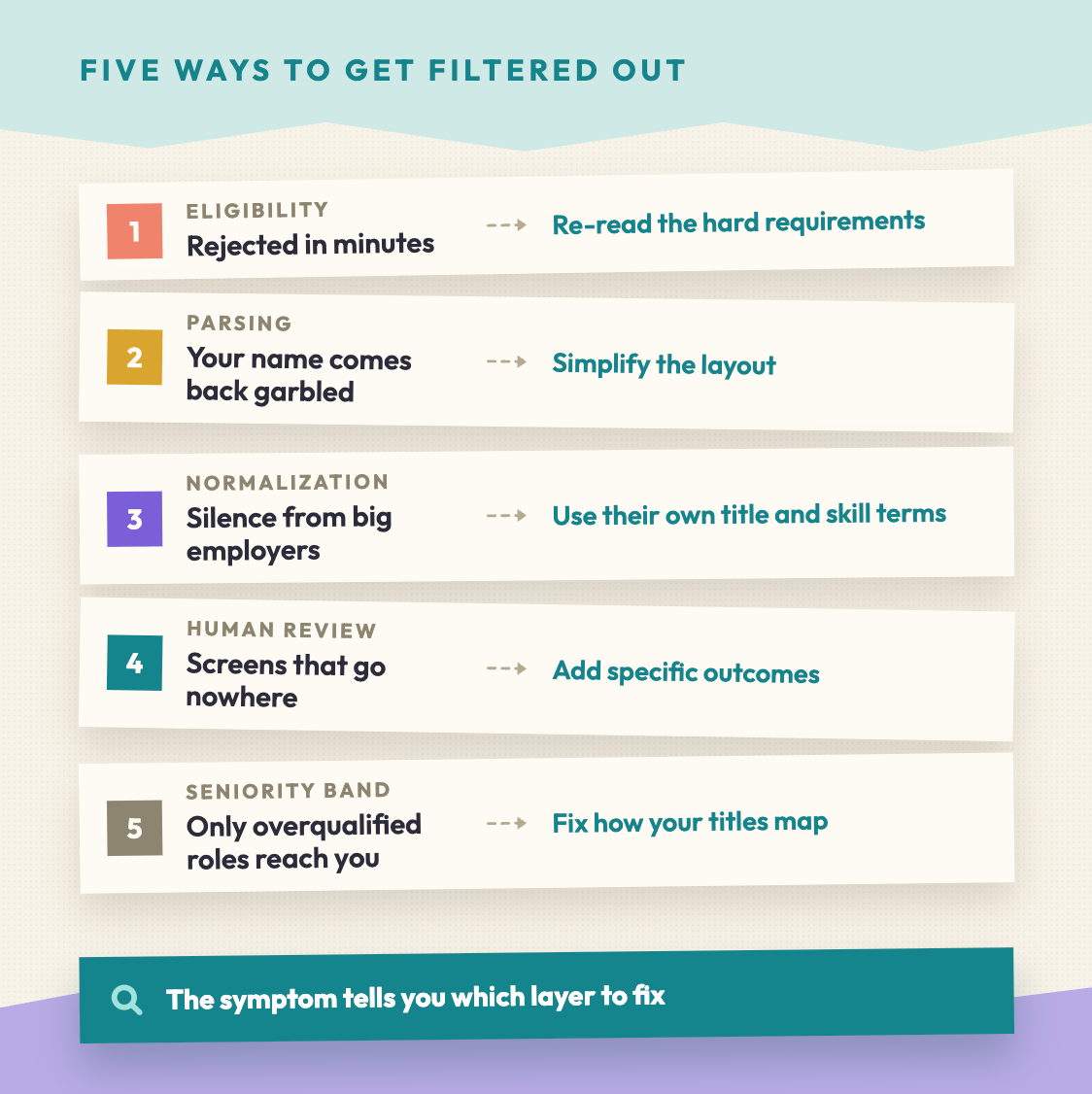
None of this is exact. Employers rarely explain rejections, and you are inferring from limited signal. Still, the pattern across twenty applications tells you more than agonizing over any single one.
A Pre-Application Checklist
Run through this before you submit, not after:
- Answer every eligibility and work-authorization question deliberately, using the employer's definitions.
- Open your PDF, select all, paste into a plain text document, and read what a parser would receive.
- Confirm each job entry has a recognizable title, an employer, and explicit start and end dates.
- Write skills using industry-standard names, with internal terminology in parentheses if you want it.
- Check that the four or five terms most central to the job description appear somewhere you can honestly support them.
- Make sure every claim in the resume has a story behind it you could tell out loud for two minutes.
- Keep a human — you — as the last check before submitting.
Frequently Asked Questions
Does a higher ATS score from an online checker mean I will get an interview?
No. Those tools measure similarity between your resume and a job description, which is a reasonable proxy for Layer 4 visibility. They cannot see the employer's eligibility rules, their parsing service, their taxonomy, or the recruiter's judgment. Treat the score as one diagnostic, not a verdict.
Should I use a PDF or a Word document?
A well-built PDF with selectable text is safe in most systems and preserves your layout. The risk is not the format itself but what is inside it — a PDF exported from a design tool as a flattened image parses as nothing at all. If an employer's portal explicitly asks for .docx, give them .docx.
Do résumé templates with columns and graphics get rejected?
They are not rejected by rule. They are simply read badly. A two-column layout can interleave unrelated content, and skill ratings drawn as bars or dots carry no information a parser can extract. The template does not fail you; the lost information does.
How many keywords from the job description should I include?
There is no correct count, and chasing one leads to stuffing. Identify the handful of requirements the role genuinely turns on, make sure your resume covers those in the employer's own words where that is truthful, and stop. Anything you cannot defend in a conversation is worth removing.
Is my resume rejected by AI before any person sees it?
Sometimes, and less often than people assume. Fully automated rejection is restricted or regulated in several jurisdictions, and many employers keep those features switched off. The more common outcome is quieter: your application is never retrieved, never ranked highly, and never actively rejected either.
Does any of this apply to small companies?
Much less. A twenty-person startup may have a founder reading every application in an inbox, with no parsing layer and no taxonomy in between. The six layers describe systems that exist because of volume, so scale your effort to the size of the employer.
Put It Into Practice
The layers you can actually control are the middle ones — how your resume is read, standardized, and retrieved.
EdAIX's Job Agent works on exactly those. Paste a job description alongside your resume and it returns an ATS match score together with a breakdown of the job's requirements — responsibilities, hard skills, soft skills, experience, education — showing which ones your resume already evidences and which ones it does not. That is Layers 3 and 4 made visible: you can see which of the employer's terms your resume currently supports before a recruiter searches for them.
Tailoring runs from the same breakdown, and it is deliberately conservative. You confirm only what is true, and gaps you choose to skip stay listed as recommendations rather than being written in for you. AI-generated content is flagged as such, because a claim you cannot defend at Layer 6 is worse than an absent one.
Vibe ID™ addresses the evidence problem underneath all of it. It turns your resume into a structured career profile — skills, experience, projects, with files you upload as proof — and publishes it as a page you can link from an application or send to a recruiter. When someone wants to verify a claim rather than take it on faith, that link is the answer.
Layer 1 stays yours. No tool should be answering work authorization or sponsorship questions on your behalf, and the answers you give there deserve more care than any keyword decision on the page.