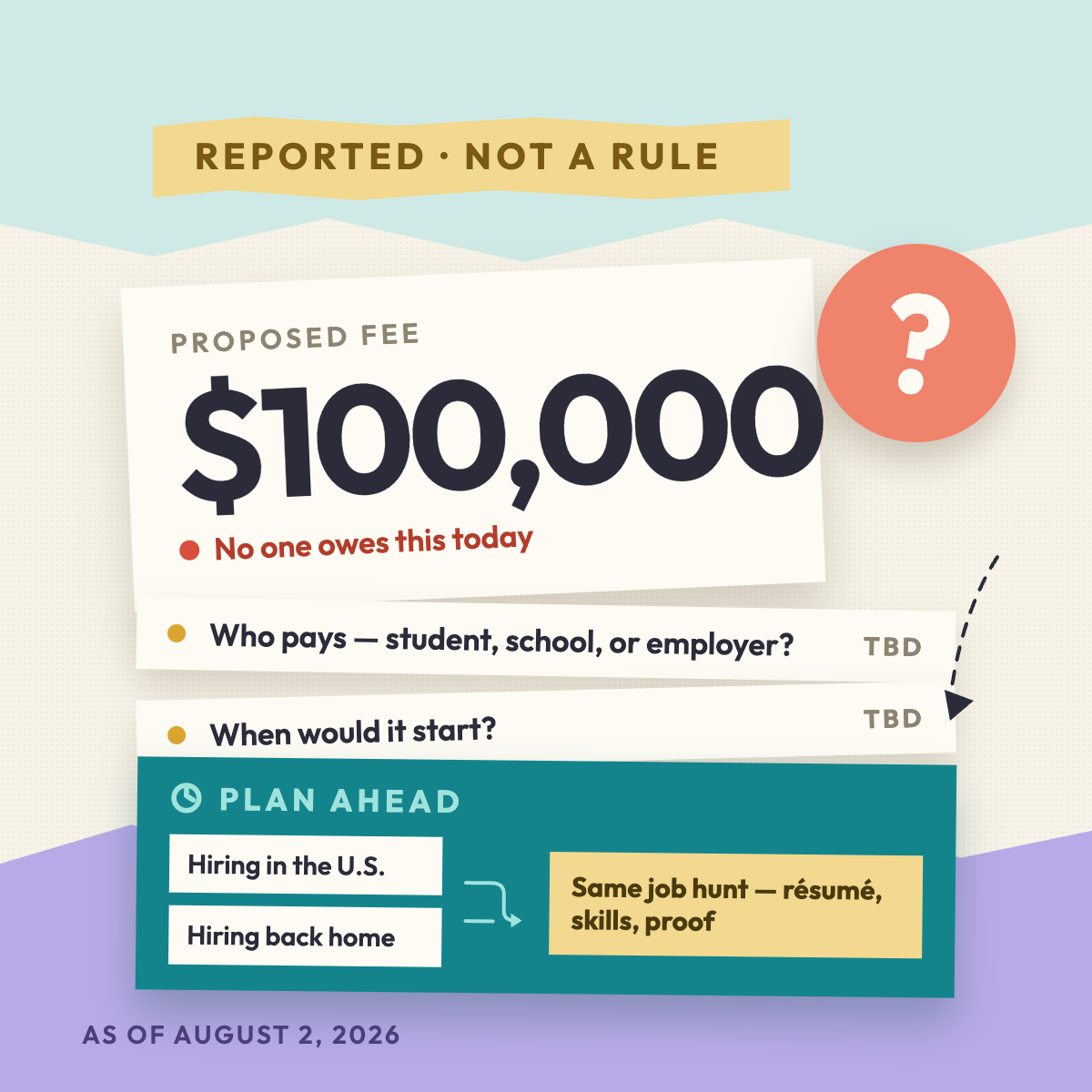

Status as of August 2, 2026: the $100,000 OPT fee remains an idea reported to be under discussion inside the government. It is not an active rule, and current OPT applicants have no new $100,000 payment obligation because of the report.
A headline claiming that Optional Practical Training could come with a $100,000 fee is spreading quickly among international students.
The number is alarming enough to make anyone reconsider a U.S. degree, a pending OPT application, or a post-graduation job search. Before changing any of those plans, there is a more basic question to answer: is this an active rule, a formal proposal, or an idea still being discussed inside the government?
As of August 2, 2026, public reporting indicates the administration is considering a fee of up to $100,000 connected to OPT. DHS and USCIS have not issued a rule requiring applicants to pay it. The final amount, the responsible payer, the covered population, and any implementation timeline are all unresolved, so the most important thing to establish first is which of those three categories this actually falls into.
This article provides general information and is not legal advice. For questions about your individual status, filing window, unemployment limits, employment relationship, travel, or change of status, consult your DSO or a qualified immigration attorney.
What Has Actually Been Confirmed
The Wall Street Journal reported on July 30, 2026 that the administration is considering a fee of up to $100,000 for international students who want to work in the United States after graduation through OPT.
The same report noted that the idea remains under discussion within DHS; that it is unclear whether the White House will approve it; that it is unclear whether students, universities, or employers would pay; that the fee could be tied to a new extension-of-status requirement; and that DHS is separately preparing broader changes to OPT rules.
DHS's own response emphasised that no policy should be treated as final until it is formally announced. The accurate description is therefore not that the United States has announced a $100,000 OPT fee, but rather that the administration is reportedly considering one that has not become an active rule.
USCIS currently describes OPT as temporary employment directly related to an F-1 student's major area of study. Existing regulations still require eligible students to file Form I-765 and pay the fee in effect at the time of filing. Current official materials do not list an active $100,000 OPT fee anywhere.
What Is Still Unknown
At least seven questions have no answer yet:
- Whether the final amount would actually be $100,000.
- Whether it would apply to all OPT applicants.
- Whether it would apply only through a new extension-of-status process.
- Whether pending or already-approved cases would be affected.
- Whether students, schools, or employers would pay.
- Whether the change would go through notice-and-comment rulemaking.
- When it could take effect, and whether it would face litigation.
Until an official document answers these, avoid treating any confident claim about who must pay, when payment would begin, or which students would be exempt as settled — including claims that sound reassuring.
Why an Unfinalized Idea Still Matters
A proposal does not have to be active to change behaviour.
Uncertainty around OPT changes how international students calculate the value of a U.S. education. For many students OPT is not a minor add-on; it is a substantial part of the expected return on the degree and the bridge between classroom learning and U.S. work experience.
A high fee assigned to employers could also change the perceived cost of hiring international graduates. Large technology and financial firms may respond differently from smaller employers with limited immigration budgets, and some may screen for status earlier in the funnel than they do today.
Work-authorization questions may simply move earlier in the recruiting process as a result. Candidates should expect more detailed questions about current U.S. work authorization, future sponsorship needs, EAD expiration dates, STEM OPT eligibility, and company-specific immigration policy. These are conditional implications rather than predictions, and the real point is that they are worth preparing for regardless of how the proposal ends.
Should Students Stop Applying for OPT?
The current facts do not support that conclusion.
No active rule requires OPT applicants to pay $100,000. Missing a filing window or abandoning a job search because of an unfinalised report creates a certain cost in response to a hypothetical one, which is the mistake most likely to do real damage here.
Students preparing for OPT should continue to follow the current Form I-765 process, confirm their personal filing window with a DSO, retain I-20s, EADs, USCIS receipts and employment records, monitor USCIS, DHS, ICE/SEVP and the Federal Register, and never make a status decision based on a screenshot or a group-chat summary.
Professional guidance matters most when status or work authorization is close to expiring, when USCIS issues an RFE, denial or revocation notice, when unemployment days or degree relevance are unclear, when travel, resignation or a change of status is under consideration, or when an individual timeline might overlap with a future rule's effective date.
What OPT Job Seekers Should Change Now
Policy outcomes are outside a candidate's control. Application decisions are not.
Identify work-authorization restrictions earlier
Before applying, look for language such as:
- Must be authorized to work in the United States
- No sponsorship available
- Will not sponsor now or in the future
- U.S. citizen or permanent resident required
- Security clearance required
- Export-control restrictions apply
These phrases are not interchangeable. "No sponsorship at this time" can mean something quite different in practice from "no sponsorship now or in the future," and roles involving citizenship, clearance or export control may carry restrictions that have nothing to do with ordinary sponsorship policy.
Separate OPT acceptance from future sponsorship
An employer may hire someone who currently holds OPT and still decline to sponsor an H-1B or another status later. Treat these as two separate questions: are you currently authorized to work in the United States, and will you require employer sponsorship in the future?
The second answer should reflect your actual situation and the precise wording of the form in front of you, instead of a generic sentence pasted into every application.
Prioritize applications using four tests
Before investing time in an application, ask whether the role is compatible with your current work authorization, whether the future sponsorship path is clear enough, whether you meet the core skill and experience requirements, and whether your résumé contains credible evidence of that match.
A high keyword match does not make a role worth applying to when the authorization requirement clearly excludes you. Where the authorization requirement is compatible but the résumé lacks evidence, tailoring is usually the better next step, and that is what deserves your limited time.
Prepare an accurate, consistent explanation
In application forms and recruiter screens, avoid hiding a likely future sponsorship need, describing an uncertain employer policy as a commitment, answering before reading the exact wording, reusing one response for every employer, or treating OPT, STEM OPT, H-1B and permanent work authorization as interchangeable terms.
Accuracy does not require a long legal explanation. In most recruiting conversations you simply need to state your current authorization, how long it runs, and whether you expect to need sponsorship later.
What to Check If a Formal Rule Appears
Do not react to the $100,000 figure alone. Check the issuing agency, the document type, whether it appears in the Federal Register, the effective date, which applicant categories it covers, whether exemptions exist, who bears the fee, how pending and approved cases are handled, and whether litigation, an injunction or a delay applies.
A practical source hierarchy runs: the Federal Register first; then DHS, USCIS and ICE/SEVP; then a university international student office or DSO; then qualified immigration counsel; then established news organisations doing original reporting; and last, social media, forums and screenshots.
News organisations may reveal internal discussions before an agency acts, which is exactly what happened here. Only an official government document can establish whether a policy is active, when it takes effect, and who it covers.
The Best Job-Search Response to Uncertainty
A practical decision sequence looks like this: verify the policy status, screen work-authorization requirements, compare job requirements, audit your résumé evidence, then apply, tailor, or move on.
International job seekers do not need every policy question resolved before acting. What matters is avoiding roles with clear authorization conflicts, large qualification gaps, or completely opaque sponsorship policies, because those are where limited application time disappears with nothing to show for it.
Frequently Asked Questions
Is the $100,000 OPT fee already in effect?
No. As of August 2, 2026 it remains a reported idea under consideration, not an active DHS or USCIS fee.
Do current OPT applicants have to pay $100,000?
No new $100,000 obligation appears in current official OPT materials. Applicants should follow the Form I-765 instructions and the fee schedule in effect when they file.
Who would pay the proposed fee?
That has not been determined. Reporting indicates students, universities or employers could each potentially be considered.
Should I delay my OPT application?
A news report alone is not a sufficient reason to miss a filing window. Confirm your individual timeline with your DSO or qualified counsel.
Does hiring someone on OPT mean the employer will sponsor an H-1B later?
No. Current work authorization and future sponsorship are separate hiring questions and should be confirmed separately.
How will I know whether the idea becomes real policy?
Look for an official publication from DHS, USCIS, ICE/SEVP or the Federal Register that includes an effective date and implementation instructions.
Put It Into Practice
When policy outcomes are uncertain, the most useful step is not guessing what comes next — it is reducing avoidable applications. EdAIX Job Agent can flag work-authorization, sponsorship, citizenship and clearance language in a job description and compare the role's requirements against the evidence in your résumé.
It cannot determine immigration eligibility and it does not replace advice from a DSO or an attorney. What it can do is help you decide, with more to go on, whether to apply now, tailor the résumé first, ask the recruiter about company policy, or move on from the role.
Sources
- The Wall Street Journal, "U.S. Weighs $100,000 Fee for Foreign Students Wanting to Work After Graduation," July 30, 2026. https://www.wsj.com/politics/policy/u-s-weighs-100-000-fee-for-foreign-students-wanting-to-work-after-graduation-d0bf43d9
- USCIS, "Optional Practical Training (OPT) for F-1 Students." https://www.uscis.gov/working-in-the-united-states/students-and-exchange-visitors/optional-practical-training-opt-for-f-1-students
- USCIS, "Fee Schedule, Form G-1055." https://www.uscis.gov/g-1055
- Study in the States, "F-1 Optional Practical Training (OPT)." https://studyinthestates.dhs.gov/sevis-help-hub/student-records/fm-student-employment/f-1-optional-practical-training-opt
- Electronic Code of Federal Regulations, 8 CFR § 214.2. https://ecfr.federalregister.gov/current/title-8/chapter-I/subchapter-B/part-214/section-214.2