
Policy status and review date: August 10, 2026. DHS published a final rule in the Federal Register on July 17, 2026, with a scheduled effective date of September 15, 2026. The rule is classified as a major rule subject to congressional review. DHS must publish another Federal Register document if the effective date changes or the rule is terminated. The rule is not yet effective as of this review.
If you are an F-1 student, you have probably now seen a dozen versions of this story, ranging from "nothing has happened yet" to "OPT is being cancelled." Both are wrong, and the gap between them is where people make expensive decisions.
The most important thing to understand about this moment is that a final rule and an effective rule are not the same thing, and the difference determines what you should actually do this month. The regulation exists, in full, with a date on it. That date has not arrived, and congressional review could still move it.
This article walks through what the rule text says, what it does not say, and which four dates you should map before September.
Start With the Rule's Actual Status
The final rule was published July 17 and lists September 15, 2026, as its effective date. Its dates section also says that congressional review could change the effective date or terminate the rule, in which case DHS will publish a new Federal Register document.
The precise description today is:
- DHS has issued a final rule.
- The new framework is not effective as of August 10.
- The September 15 date and implementation notices still require monitoring.
- Calling the rule merely "proposed" is outdated, while treating commentary as regulatory text is also inaccurate.
Both errors cause real harm. Treating it as a proposal leads students to make no preparations for a framework that may be six weeks away. Treating a summary article as the rule itself leads students to withdraw from programs or pay deposits based on provisions that do not exist. Read the Federal Register text, or ask someone whose job is to read it.
Fixed Admission Dates Replace D/S
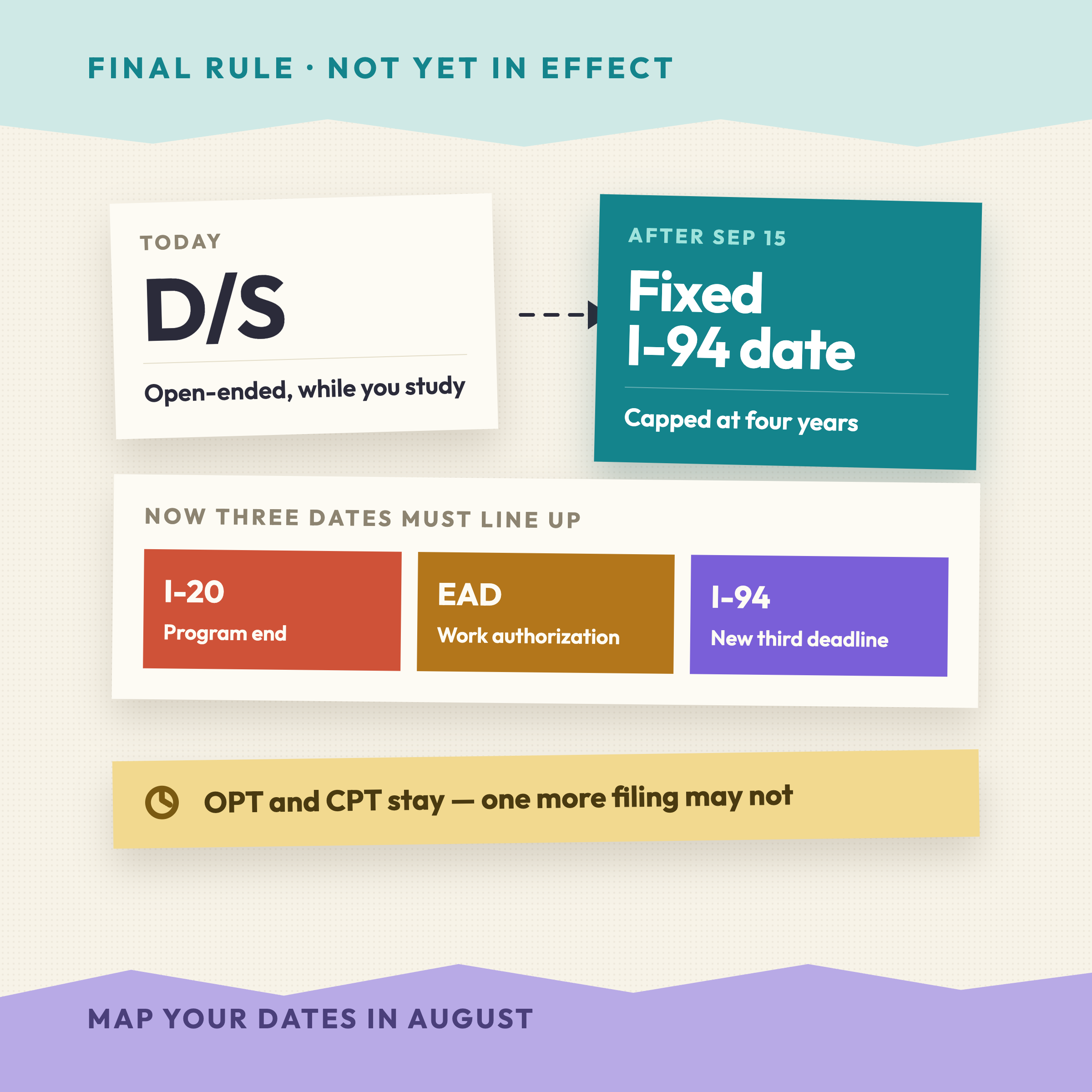
Under the familiar system, many F-1 I-94 records show D/S. A student can generally remain while pursuing an authorized course of study or practical training and maintaining status. The new rule replaces that open-ended notation with a specific admit-until date.
For a new admission or readmission, the period generally follows the program end date on Form I-20 and may not exceed four years. The 30-day pre-program arrival window and the additional 30-day departure period do not count toward the four-year maximum. A student whose academic program, next program or authorized training extends beyond the I-94 date may need to file an Extension of Stay with USCIS or, when appropriate, depart and seek readmission.
The operational consequence is easy to state and easy to overlook. Your I-20 and your EAD stop being the only dates that matter, and the I-94 expiration becomes a third deadline that has to be reconciled against both of them.
OPT and STEM OPT Continue, but the Filing Stack Changes
The final rule preserves post-completion OPT and STEM OPT. Students still need DSO recommendations and must satisfy the existing eligibility and filing requirements, including Form I-765 where applicable. The additional issue is whether the requested training period fits inside the student's fixed admission period. If it does not, an Extension of Stay — generally using Form I-539 — may also be required.
Students properly maintaining F-1 status under D/S on September 15 receive a transition period. Their authorized stay generally runs to the later of the program end date on Form I-20 or the EAD expiration date, subject to a four-year cap measured from the effective date. This transition group retains a 60-day departure period and may not remain beyond November 14, 2030, under the transition provision. The general departure period under the new fixed-admission framework is 30 days. Those needing additional time for a current program, post-completion OPT, STEM OPT or a new program may need an EOS filing.
The real change here is not that OPT disappeared. It is that a second filing may now sit between you and training you already qualify for, and that filing has its own timing rules.
A limited transition exception runs through March 18, 2027
For eligible students covered by the transition rule, a timely post-completion OPT or STEM OPT I-765 filed on or before March 18, 2027, can remove the need for a separate I-539 for the requested training period. DHS reserved authority to extend this temporary exception in six-month increments.
March 18 is not a universal OPT deadline. It is a temporary EOS-filing exception layered onto the normal OPT and STEM OPT rules, and it applies only to students who fall inside the transition group. Confirm with your DSO whether you are in that group before planning around the date.
Filing during the last 30 days can interrupt work
The final rule permits a timely EOS filing during the 30-day departure period. But when USCIS receives it during that period, the student may continue a full course of study and may not begin or continue practical training or other employment until the EOS is approved and, when required, an EAD is issued.
For a student already working, that distinction is the difference between a paperwork task and a paused paycheck. The biggest practical risk in this transition is a date mismatch nobody notices until an EAD is already expiring, which is why the planning work belongs in August rather than in the week the rule takes effect.
Transfer and Major Rules Split by Education Level
If the provisions take effect as written:
- Graduate level and above: a student may not change educational objectives — defined to include major or education level — during the program. The student also may not transfer during the program unless SEVP authorizes an exception for extenuating circumstances.
- Below graduate level: a student may not transfer or change educational objectives during the first academic year, absent an SEVP-authorized exception. After completing the first academic year, the rule permits the change.
- After program completion: a student may progress to a higher educational level. A person who completes a U.S. F-1 program after the rule's effective date may not maintain, obtain or be admitted in F-1 status through a program at the same or a lower level.
The rule also gives DHS limited authority to delay or suspend educational-objective provisions if implementation is infeasible, with notice through the Federal Register and SEVP website. Do not treat the July text as the final word on timing if your transfer is time-sensitive; watch the implementation notices, because a provision that is suspended for system reasons behaves differently from one that is in force.
What This Actually Does to Day 1 CPT
"Day 1 CPT" is an industry shorthand, not a separate visa classification. CPT remains part of the F-1 framework and still must be an integral part of the established curriculum under the applicable rules.
The final rule does not say that all Day 1 CPT is prohibited. Instead, it attacks a common entry route: a person who completes a U.S. master's program can no longer rely on a second master's or lower-level program to obtain or maintain F-1 status. The ban on graduate-level transfers during a program, subject only to an SEVP exception for extenuating circumstances, adds another constraint.
The accurate takeaway is:
- CPT still exists.
- A student first entering a genuinely higher education level still needs an individual CPT analysis.
- A repeat same-level degree used to continue F-1 status and start CPT immediately will face a direct barrier.
- A school's accelerated calendar or marketing language cannot by itself override federal degree-level and transfer restrictions.
What matters for a Day 1 CPT plan is not the label the school uses but your own prior U.S. degree level and the date you completed it. Treat any promise of "guaranteed CPT" as a warning sign when the provider has not reviewed your prior U.S. degree level, completion date, I-94 and SEVIS history.
Five Planning Scenarios
Current student with no immediate travel
- Save the latest I-94, every I-20 and travel record.
- Ask the DSO how the transition rule applies to the program and EAD dates.
- If completion may take longer, plan the EOS window early.
- Do not assume that extending an I-20 automatically extends a fixed I-94.
Student planning a fall transfer or major change
- Identify whether the program is below graduate level or graduate level and above.
- Check the SEVIS release date, new program start date and effective date.
- Graduate students should not assume that a completed SEVIS transfer alone resolves the new restriction.
- Ask the DSO about the formal process and evidence for any claimed extenuating-circumstances exception.
Student preparing for post-completion OPT
- Put the I-20 end date, I-94 expiration and I-765 filing window on one timeline.
- Determine whether the March 18, 2027, transition exception could apply.
- If the training period exceeds the admission period, confirm whether and when Form I-539 is needed.
- Do not miss the underlying OPT filing window while solving the EOS question.
Student on OPT preparing for STEM OPT
- Reconcile the EAD end date, I-94 date and STEM OPT filing window.
- Continue checking the existing E-Verify, Form I-983 and employment-relationship requirements.
- Confirm how an EOS filing and the existing 180-day EAD extension apply to the individual case.
- Review travel documents before leaving the United States with a pending filing.
Student treating a second master's as an H-1B backup
- Identify the highest U.S. degree level already completed and its completion date.
- Evaluate F-1 eligibility before reviewing a school's CPT marketing.
- Discuss alternatives with the employer early without assuming sponsorship will be available.
- Obtain independent DSO and legal review before paying tuition or signing an enrollment agreement.
The Job Search Needs a Documentation Layer
Employers will continue to ask about current authorization and future sponsorship in different ways, and the rule does not standardize any of it. Save the exact answers submitted in applications, written recruiter explanations and final offer language.
Inconsistency across those records can become a practical problem even when no single screening question tells the full story. A student who answers one application "no sponsorship needed" because OPT covers the start date, and another "sponsorship required" because H-1B will eventually be necessary, has not done anything wrong — but should be able to explain both answers from saved documents rather than from memory.
Frequently Asked Questions
Is September 15 guaranteed to be the effective date?
It is the date listed in the final rule. The rule is subject to congressional review, and DHS says it will publish a new Federal Register document if the date changes or the rule is terminated. The rule is not yet effective as of August 10, 2026.
Will current D/S students lose status immediately on September 15?
Not solely because the date arrives. The rule contains a transition period for people properly maintaining F or J status on the effective date. The individual end date depends on the I-20 or DS-2019, EAD and the transition cap.
Is Day 1 CPT completely banned?
No. CPT remains in the regulations. The major change is that a student who completes a U.S. program after the effective date cannot use a same- or lower-level program to maintain or obtain F-1 status, eliminating a common second-master's pathway.
Will every OPT applicant need Form I-539?
Not necessarily. The answer depends on the student's admission period, filing date and transition eligibility. Some transition cases with a timely I-765 filed by March 18, 2027, receive a temporary I-539 exception.
What happens after international travel?
Under the fixed-period framework, CBP may issue a new specific admission end date based on the current I-20, EAD and supporting documents. Travel can also interact with a pending EOS. Review current instructions with the DSO or counsel before departure.
Should I change my plans before the rule takes effect?
That depends entirely on which of the five scenarios above describes you, and it is a question for your DSO rather than for an article. What every student can do now is assemble the documents and dates that any adviser will ask for first, so the conversation starts from facts instead of from reconstruction.
Put It Into Practice
Build a four-date timeline today: I-20 program end date, I-94 expiration, EAD expiration and the next transfer, OPT or STEM OPT filing window. Have the DSO review it with every prior I-20. Seek qualified immigration counsel early if the plan involves a repeat degree, graduate transfer, EOS filing or international travel.
For the employment side of that timeline, EdAIX Job Agent works on the job-fit question rather than the status question. Its browser extension scores a posting you are viewing on LinkedIn, Indeed or Built In against your resume and returns a 0-100 match score, a Strong, Good or Weak Match verdict, your strongest matches, your gaps, the keywords you are missing, one recommended action before you apply, and whether the posting itself mentions sponsorship as Yes, No or Not mentioned. That last field reads what the employer wrote; it is not a judgment about your eligibility.
The distinction is worth stating plainly, because this is exactly where tools get oversold. Job Agent cannot determine your F-1, OPT, CPT or EOS eligibility, cannot tell you whether the September 15 date will hold, and cannot guarantee that any employer will sponsor. Those answers come from current government guidance and from individual review by your DSO and qualified counsel, working from your own documents.
Focus your August on the dates you control rather than on the effective date you do not.
Sources
- Federal Register / GovInfo — Final Rule: Establishing a Fixed Time Period of Admission and an Extension of Stay Procedure
- Federal Register — Final Rule Landing Page
- DHS — Trump Administration Issues Final Rule to End Foreign Student Visa Abuse
- Study in the States — Final Rule Quick Reference
Disclaimer
This article is for educational and general informational purposes only and is not legal or immigration advice. The rule is not yet effective, and its effective date, implementation, form instructions and application to individual cases may change. Check current DHS, USCIS, ICE, SEVP and Federal Register materials, and consult your DSO and qualified U.S. immigration counsel about your circumstances.