
EdAIX
返回博客
Career Advice2026年8月

Summer 2027 Internship Timeline by Industry

Summer 2027 internship applications opened in three waves. Banking closed in early 2026, Big Tech opens now, and everything else runs through spring 2027.

Summer 2027 Internship Timeline by Industry
Yvonne
11 分钟阅读
Data review date: August 11, 2026. Dates below come from recruiting trackers and industry timelines, not from company announcements. Employers change windows without notice, so verify every one on the official careers page before you plan around it.
💡
摘要
Summer 2027 recruiting runs in three waves. Bulge-bracket banks opened and closed between December 2025 and January 2026 and had largely filled their classes by May 2026. Big Tech is opening between July and October 2026. Most other employers post from November 2026 through spring 2027, so what matters now is knowing which wave your target industry is in.

Search for a Summer 2027 internship timeline and you will find a dozen articles telling you when to apply. Almost all of them are written as though every reader arrives at the same moment, and in August 2026 that framing is actively misleading.

Depending on the industry you are targeting, you are either three months early, exactly on time, or about eight months too late. The most important thing to establish right now is not a calendar. It is which of those three you are.

Where You Actually Stand in August 2026

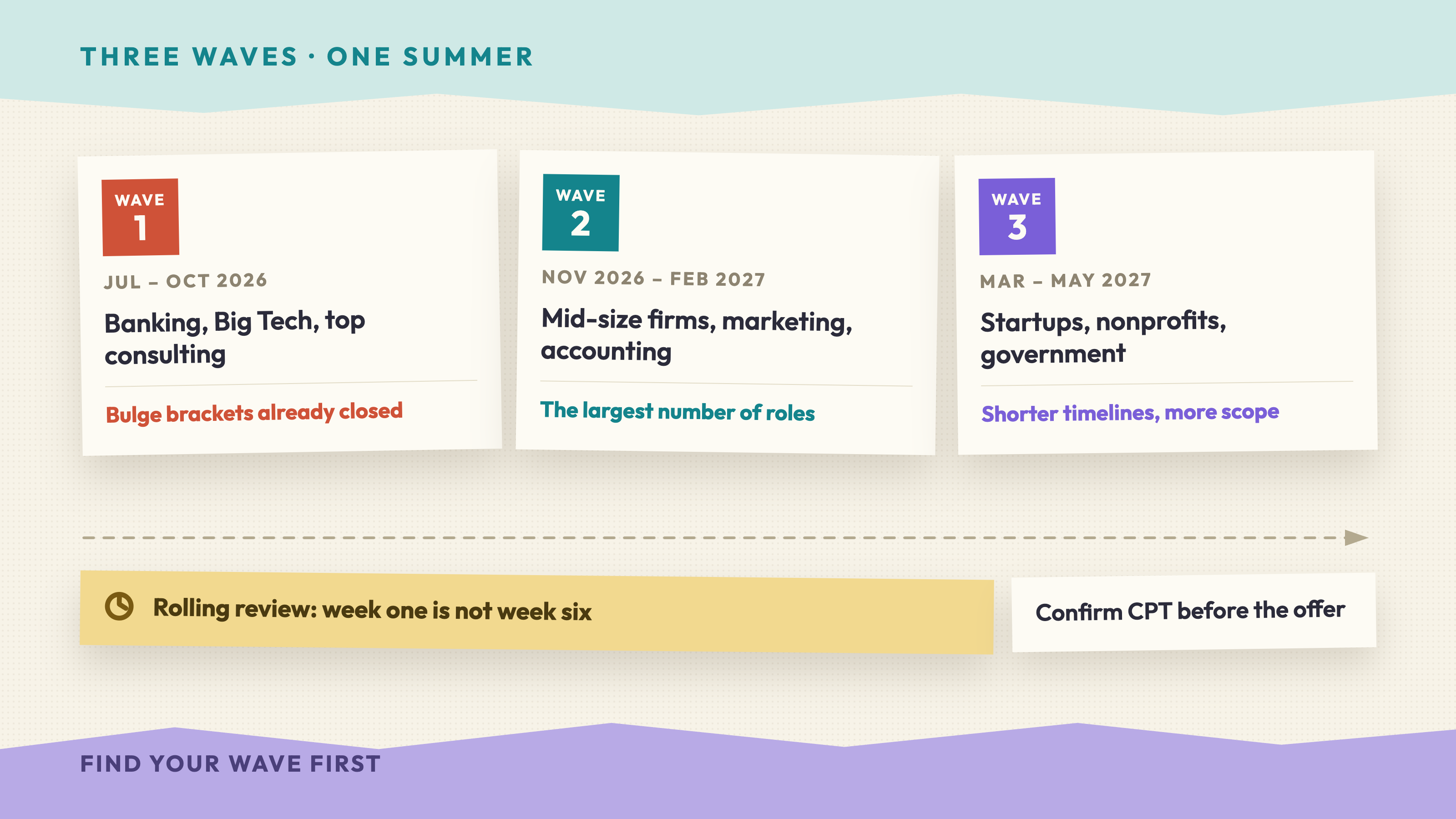
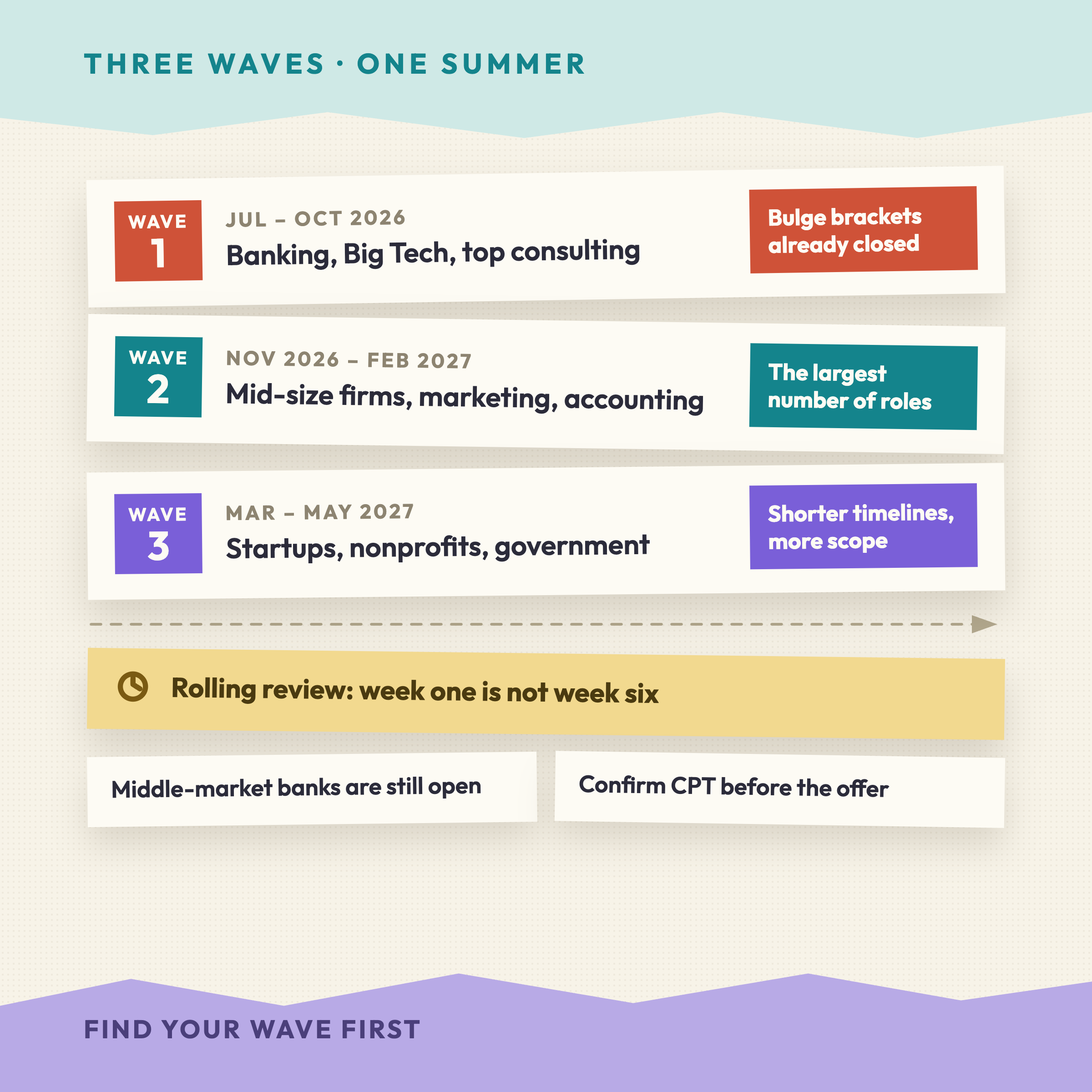
Recruiting for Summer 2027 runs in roughly three waves.

Wave 2 holds the largest number of roles by a wide margin, which is worth knowing before you panic about Wave 1. But Wave 1 contains the roles with the most name recognition, and that is where the timeline has moved so far forward that it now catches people out.

Wave 1a: Banking Opened and Closed Before You Heard About It

This is the part that surprises people, so it goes first.

According to recruiting timelines published by Adventis and Wall Street Playbook, Goldman Sachs, JPMorgan, Citi, Bank of America, Morgan Stanley, Barclays, Deutsche Bank, UBS and Wells Fargo all opened and closed their Summer 2027 analyst applications between December 2025 and January 2026. Interviews ran through spring, and those classes were largely filled by May 2026. Elite boutiques including Evercore, Centerview, Lazard, PJT, Moelis and Perella Weinberg began even earlier, with some 2027 processes starting in fall 2025.

For a student reading this in August 2026, that means the bulge-bracket door for Summer 2027 is closed. Not competitive — closed.

What is not closed is the rest of the industry. Of roughly 180 banks tracked by recruiting data services, only about 110 had posted 2027 roles by June 1, 2026. The remainder, overwhelmingly middle-market and regional firms, post from summer through late fall 2026. So if finance is your target and you missed the bulge brackets, the useful move is not to mourn the deadline you never saw. It is to work the list of firms whose windows are opening this month.

Wave 1b: Big Tech Is Opening Right Now

Tech runs several months behind banking and is live as you read this.

Summer 2027 tech internships open between July and October 2026. Amazon and Databricks historically post first, in July and August. Microsoft and Apple follow in September. Google's software engineering internship window opens around mid-October and, by most accounts, closes within two to four weeks. Google and Microsoft postings typically close by November.

Two things follow from that, and the second matters more than the first. Short windows mean a posting you notice in week three may already be gone. And because nearly every one of these programs reviews on a rolling basis, an application submitted in the first week is genuinely not competing against the same pile as one submitted in the sixth.

Engineering sits alongside tech with its own quirk: aerospace and defense employers open as early as August 2026, while most mechanical, civil and biomedical programs post from September through January. Defense contractors frequently require citizenship or clearance, which is a hard filter rather than a preference, so read those requirements before investing time in the application.

Wave 2: Where Most of the Roles Actually Are

From November 2026 through February 2027, the bulk of the market posts: mid-size companies, brand-side marketing, accounting, healthcare, most engineering, and the long tail of employers who do not run a formal early pipeline. December through February is the peak.

If you are a first-year master's student who arrived in Fall 2026, this is your realistic wave, and treating it as the consolation prize is a mistake. The roles here are less publicized, which also means the applicant pools are smaller and the process is more responsive to a genuinely targeted application.

Wave 3: March Through May 2027

Startups, nonprofits, government agencies and smaller employers hire on much shorter timelines, often without a formal program until spring. Wave 3 gets dismissed as leftovers, which is wrong on the merits — a twenty-person company that decides in March that it needs help in June can offer more responsibility than a structured program at a company with two thousand interns.

The real trade-off is different. Wave 3 offers less lead time for visa and start-date logistics, which is exactly the constraint international students should be planning around from now.

Why the Timeline Keeps Moving Earlier

Each firm that opens earlier gains first look at a candidate pool, so the next firm opens earlier still. The result is banking recruiting for a summer that begins eighteen months later, evaluating sophomores who have completed roughly three semesters of coursework.

Understanding the mechanism is more useful than complaining about it, because it tells you what to do: the calendar you need is not this year's, it is next year's. If you are targeting Wave 1 for Summer 2028, your work starts in fall 2026, not in the summer before.

The Layer Most Timelines Leave Out

Every article above this one stops at the calendar. For an international student, the calendar is only half the problem, and the other half has a longer lead time.

Under USCIS policy, an F-1 student generally must have been lawfully enrolled full time for one full academic year before becoming eligible for CPT, which is the authorization most summer internships run on. There is an exception for graduate students whose program requires immediate participation in an internship or field placement as part of the curriculum, but whether your program qualifies is a question for your DSO and not for a blog post.

Do the arithmetic before you accept anything. A student starting a program in Fall 2026 completes that first academic year around May or June 2027, which can land within days of a Summer 2027 internship start date. That is not a reason to skip applying. It is a reason to raise the start date with your DSO now, while the date is still negotiable, rather than in April when it is not.

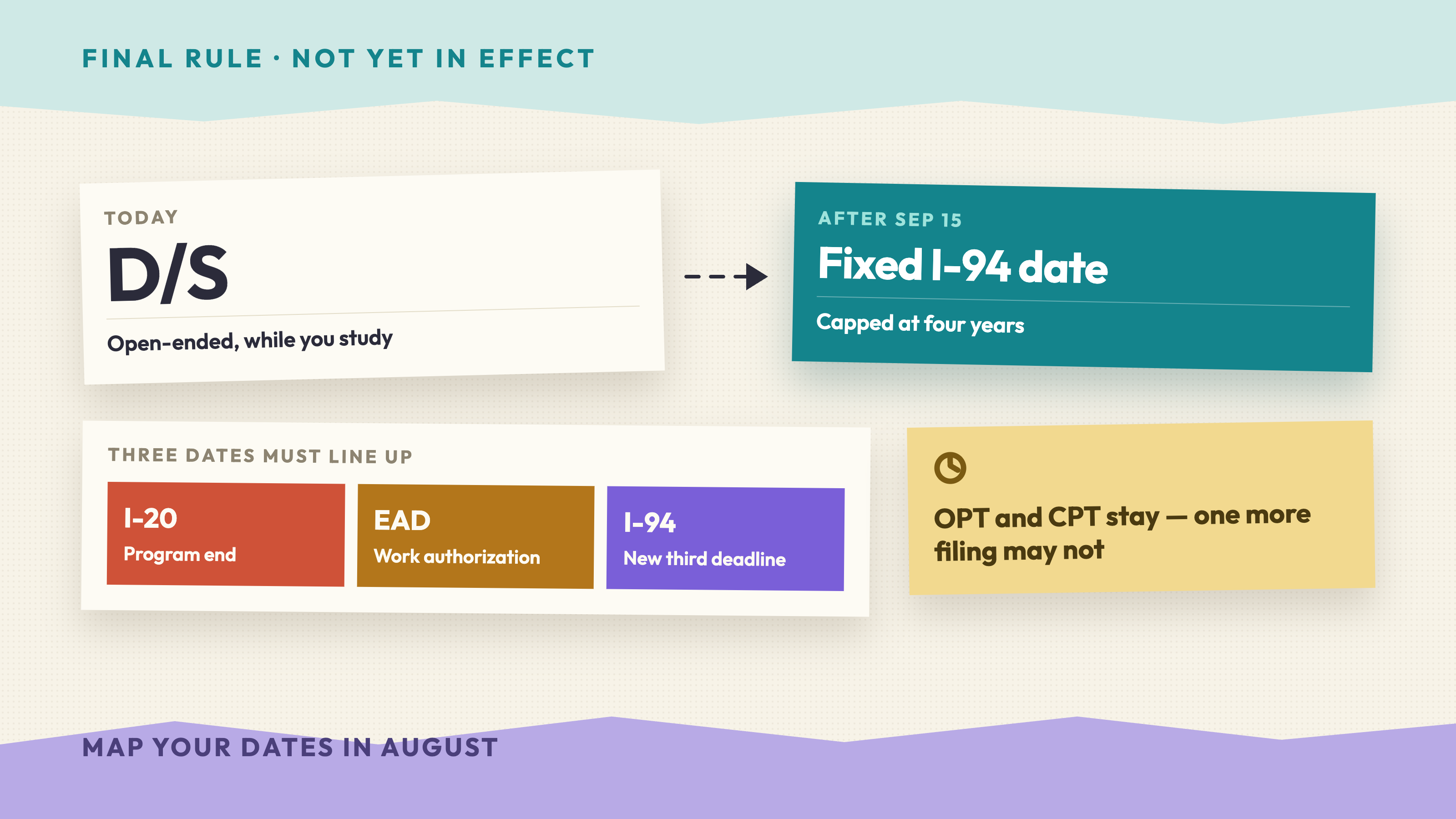
One more variable applies this cycle specifically. DHS has issued a final rule replacing F-1 duration of status with fixed admission periods, scheduled to take effect September 15, 2026 and not yet effective as of this review. If it takes effect as written, your I-94 will carry a specific end date that has to be reconciled against your program dates and any work authorization. Anyone planning a Summer 2027 internship should be tracking that date alongside the application windows.

What Sponsorship Means for an Internship

Internship applications ask about work authorization differently from full-time applications, and advice written for full-time roles transfers badly.

Many employers who will not sponsor an H-1B will still hire a CPT intern, because the intern authorization is one you obtain through your school rather than something the employer petitions for. Others screen out any candidate who will require future sponsorship, on the theory that the internship is a pipeline to a full-time offer. Both are common, and the posting frequently says nothing either way.

Never treat silence in a job posting as a rejection. Ask the recruiter, get the answer in writing, and keep your answers consistent across every application — an inconsistency you cannot explain costs more than an early no.

Frequently Asked Questions

I am reading this in August 2026. Is it too late for Summer 2027?

For bulge-bracket investment banking, yes. For Big Tech, you are early or exactly on time. For most other industries, you are months ahead of the main window. The answer depends entirely on the industry, which is why a single timeline article cannot answer it for you.

Do these dates apply every year?

Treat them as this cycle's pattern, not a rule. Windows have moved earlier every year recently, and individual employers change without notice. Anything you plan around should be confirmed on the company's own careers page.

Does applying on day one actually matter?

For rolling-review programs, yes, and the effect is larger than most students expect. Interview slots fill as strong applications arrive, so a later application is evaluated against a smaller number of remaining seats.

Should I apply if I miss two or three listed requirements?

Usually yes, if the gaps are preferred qualifications rather than hard ones. A hard requirement is different: citizenship or clearance for defense work, or a graduation-year restriction, will not bend, and applying anyway spends time you could give to a real chance.

As an international student, when should I raise work authorization?

Confirm your own CPT eligibility with your DSO before you accept anything, and ask the employer about their policy when it is not stated in the posting. What you should not do is answer authorization questions on an application based on a guess.

What if my program does not allow a summer internship at all?

Some programs do not, and some allow it only for academic credit under specific conditions. That is a question with a definite answer available from your DSO right now, and the cost of finding out in March instead of August is an entire recruiting cycle.

Put It Into Practice

Do the wave question first, this week. Everything else in this article is downstream of knowing whether you have two weeks or five months.

Working backward from where the windows actually are:

  1. This week, decide which wave your target industry is in, and build the company list for it rather than a generic list of names you recognize.
  2. Next week, fix the resume once, properly, before applications open rather than editing it under deadline pressure at midnight.
  3. Week three, set alerts on the official careers pages of your top twenty companies. Aggregators lag, and in a two-week window that lag is the whole window.
  4. Week four, take your CPT timing question to your DSO in writing, with your program start date, expected first-academic-year completion date and target internship start date on one page.

Once your list exists, EdAIX Job Agent can compress the per-application work. Its browser extension scores a posting you are viewing on LinkedIn, Indeed or Built In against your resume and returns a 0-100 match score, a Strong, Good or Weak Match verdict, your strongest matches, your gaps, the keywords you are missing, one recommended action before applying, and whether the posting mentions sponsorship as Yes, No or Not mentioned. In a two-week window, knowing which five of forty postings deserve a tailored resume is worth more than the tailoring itself.

Two limits, because this article is about not being caught out by things nobody told you. The sponsorship field reports what the employer wrote in the posting, which for internships is frequently nothing at all, and it cannot determine your CPT eligibility or predict whether a company will sponsor later. Those answers come from your DSO, the employer and qualified counsel, working from your own documents.

Sources

核心要点
Bulge-bracket banking Summer 2027 is effectively over,middle-market and regional firms are not
Big Tech opens July to October 2026, and several windows close within weeks.
Most industries post between November 2026 and February 2027.
Rolling review means an application submitted in week one is not the same as one in week six.
International students should confirm CPT eligibility before the offer, not after.
Yvonne

相关阅读

把求职方法送到你的邮箱

每月一封,精选拆解与学生故事。绝不打扰。

免费注册